

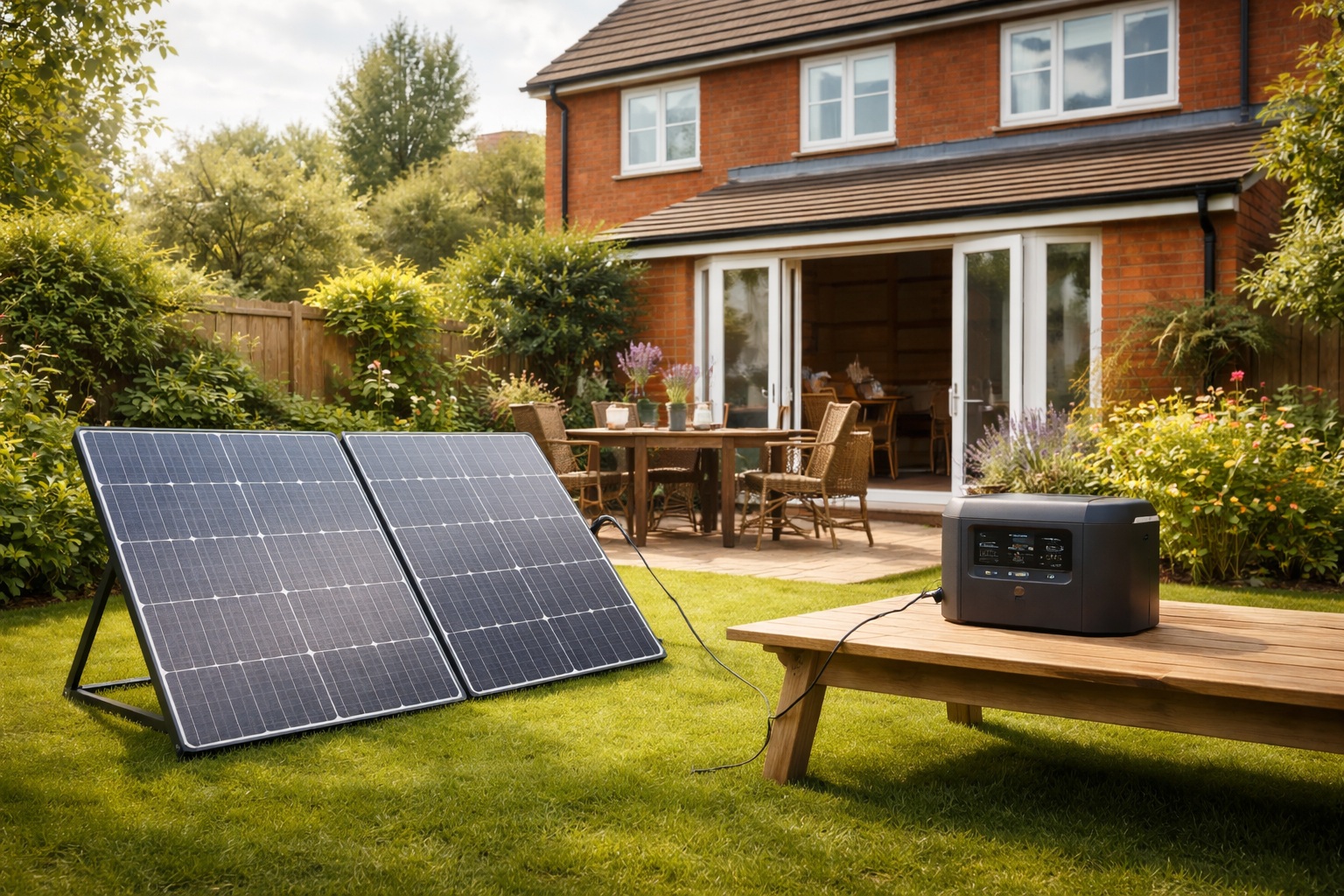
Quick answer: can I generate my own electricity at home in the UK?
Yes — and you do not need planning permission, a specialist installer, or a £10,000 roof installation to start. A portable solar panel connected to a power station is the simplest entry point: one 200W panel + EcoFlow RIVER 2 Pro costs around £650–£750 and generates enough electricity each sunny day to charge phones, run a laptop, power LED lighting, and keep a mini-fridge running for several hours. For renters and flat dwellers, a balcony solar kit starting at around £400–£700 reduces electricity bills with no roof access needed. For homeowners wanting serious energy independence, a £1,500–£3,000 portable system covers most daily essential loads. A full rooftop grid-tied installation averages £7,000–£10,000 but is outside the scope of this guide.
UK electricity prices have roughly doubled in the last decade. The grid is not getting cheaper. Solar technology, meanwhile, has dropped over 80% in cost since 2010. The intersection of these two trends means generating your own electricity at home — even partially — has never made more financial sense than it does right now.
This guide covers every level of home solar power, from a single portable panel for £150 to a full 3,000W off-grid system, plus balcony solar for renters, battery storage for grid-off-peak arbitrage, garden office power, and the DIY setup knowledge that most guides skip entirely.
👉 Already interested in portable power for camping, festivals, and van life? See our best portable power for camping UK guide for the outdoor-specific breakdown.
Master setup comparison table
Quick answer: what solar setup do I need for my situation?
The right setup depends entirely on what you want to power and how much you want to spend. £500–£750 covers phone and laptop charging plus emergency backup. £1,000–£1,500 covers daily essentials including lighting and a fridge. £2,000–£3,000 covers near-complete energy independence for a small home or cabin. Every setup in this guide is portable, requires no planning permission, and can be built incrementally — start small and add panels or capacity as your needs grow.
| Setup | Budget | Panels | Storage | Daily output (summer) | What it runs | Best for |
|---|---|---|---|---|---|---|
| Starter | ~£150–£300 | 1× 100W | Power bank only | ~400Wh | Phones, laptop, lights | Testing, camping, emergency backup |
| Entry | ~£500–£750 | 1× 200W | 500–800Wh station | ~700–800Wh | Laptop, lights, phone, fan | Home office, renters, first setup |
| Mid | ~£1,000–£1,300 | 2× 200W | 768–1,000Wh station | ~1,200–1,400Wh | + Mini-fridge, TV, CPAP | Regular home backup, garden office |
| Serious | ~£1,500–£2,000 | 4× 200W or 2× 400W | 1,500–2,000Wh station | ~2,000–2,800Wh | Most essential home loads | Power cuts, off-grid cabin, static caravan |
| Full off-grid | ~£2,500–£3,500 | 4× 400W+ | 2,000–4,000Wh station + expansion | ~4,000–6,000Wh | Near complete home power | Off-grid living, van life, full independence |
How home solar works — the basics
Quick answer: how does a home solar panel system work?
Solar panels convert sunlight into direct current (DC) electricity. A charge controller manages the flow of that DC electricity into a battery, preventing overcharging. An inverter converts the stored DC electricity to alternating current (AC) — the type your home appliances use. In an all-in-one portable power station (EcoFlow, Jackery, Bluetti), all three components are built into one unit. In a DIY system, you buy and wire each component separately.
The four components of any solar system
| Component | What it does | All-in-one station? | DIY equivalent |
|---|---|---|---|
| Solar panel | Converts sunlight to DC electricity | Separate — connect to station | Rigid or folding panel with MC4 connectors |
| Charge controller | Regulates current into battery — prevents overcharge | ✅ Built in (MPPT) | Renogy MPPT controller (~£40–£80) |
| Battery | Stores electricity for use when sun is not shining | ✅ Built in (LiFePO4 or NMC) | LiFePO4 battery pack (~£200–£800) |
| Inverter | Converts DC to AC for home appliances | ✅ Built in (pure sine wave) | Pure sine wave inverter (~£60–£200) |
Grid-tied vs off-grid vs hybrid
Quick answer: what is the difference between grid-tied and off-grid solar?
Grid-tied systems connect to your home’s electrical wiring and feed power directly into your circuits — or export surplus to the grid via the Smart Export Guarantee (SEG). Requires MCS-certified installation and G98/G99 notification. Off-grid systems (the focus of this guide) store power in batteries and operate completely independently from the grid — no connection, no registration required for portable systems. Hybrid systems combine both: generate solar, store in batteries, and connect to the grid as backup.
UK solar yield — what to realistically expect
Quick answer: how much electricity does a solar panel generate in the UK?
A 200W panel in the UK generates approximately 600–800Wh on a good summer day (4–5 peak sun hours) and 100–250Wh on a typical overcast winter day. UK average peak sun hours range from 4–5 hours in summer (south) to 1–2 hours in winter. Solar panels do not stop working in cloud — they generate around 10–25% of peak output in diffuse light. Annual generation per 1kWp of panel capacity averages 800–1,100kWh depending on location and orientation.
| Panel wattage | Summer daily (4–5 hrs) | Autumn/spring (2–3 hrs) | Winter (1–2 hrs) | Annual estimate |
|---|---|---|---|---|
| 100W | ~350–450Wh | ~180–280Wh | ~80–160Wh | ~80–110kWh |
| 200W | ~700–900Wh | ~360–560Wh | ~160–320Wh | ~160–220kWh |
| 400W | ~1,400–1,800Wh | ~720–1,120Wh | ~320–640Wh | ~320–440kWh |
| 800W (2× 400W) | ~2,800–3,600Wh | ~1,440–2,240Wh | ~640–1,280Wh | ~640–880kWh |
| 1,600W (4× 400W) | ~5,600–7,200Wh | ~2,880–4,480Wh | ~1,280–2,560Wh | ~1,280–1,760kWh |
Estimates based on south-facing installation at 30–35° tilt. North-facing reduces output by 20–30%. Cloud cover is factored into UK averages. All figures approximate.
UK solar yield by region
| Region | Annual peak sun hours (approx.) | 200W panel annual output |
|---|---|---|
| South-west England / Cornwall | ~1,050–1,150 hrs | ~200–230kWh |
| South-east England / London | ~1,000–1,100 hrs | ~190–220kWh |
| Midlands | ~900–1,000 hrs | ~170–200kWh |
| North England / Yorkshire | ~850–950 hrs | ~160–190kWh |
| Scotland (central) | ~750–850 hrs | ~140–170kWh |
| Scotland (highlands) | ~650–750 hrs | ~120–150kWh |
Solar panel types explained — monocrystalline vs polycrystalline vs ETFE
Quick answer: what type of solar panel is best for UK home use?
For portable home use in the UK: monocrystalline ETFE panels are the best choice. Monocrystalline cells are more efficient (20–24% vs 15–17% for polycrystalline) — critical in the UK’s lower light conditions. ETFE (ethylene tetrafluoroethylene) surface coating is more durable and scratch-resistant than PET laminate, maintains efficiency better in wet conditions, and is the construction used by EcoFlow, Jackery, and Bluetti in all their portable panels. For fixed rooftop or garden installations, monocrystalline glass-fronted rigid panels offer the best balance of efficiency, durability, and cost.
| Panel type | Efficiency | Cost | Best for | UK weather performance |
|---|---|---|---|---|
| Monocrystalline (ETFE folding) | 20–24% | Higher | Portable home setups, camping | ✅ Excellent — works well in diffuse light |
| Monocrystalline (glass rigid) | 20–23% | Mid | Fixed garden/roof installations | ✅ Excellent |
| Polycrystalline (glass rigid) | 15–17% | Lower | Budget fixed installations | ⚠️ Adequate — less efficient in UK conditions |
| PERC monocrystalline | 21–25% | Higher | Space-constrained installations | ✅ Best efficiency per square metre |
| Bifacial monocrystalline | 22–26% (front + rear) | Higher | Elevated or reflective surfaces | ✅ 5–15% extra from rear light capture |
What is bifacial solar and is it worth it in the UK?
Quick answer: are bifacial solar panels worth it in the UK?
Yes — particularly for portable systems where the panel is elevated off the ground. A bifacial panel generates power from both front (direct sunlight) and rear (reflected/diffuse light) surfaces. In UK outdoor conditions with light reflected from grass, gravel, paving, or light-coloured surfaces, bifacial panels produce 5–15% more power than equivalent monofacial panels. The EcoFlow 220W Bifacial is the benchmark portable bifacial panel — browse EcoFlow 220W Bifacial on Amazon.
Solar panel orientation and tilt — optimising for UK conditions
Quick answer: which direction should solar panels face in the UK?
South-facing at 30–35° tilt is optimal for maximum annual energy generation in the UK. South-southeast or south-southwest (within 45° of true south) reduces output by only 5–10%. East or west-facing panels produce approximately 15–20% less than south-facing. North-facing panels produce 30–40% less and are not recommended. For portable panels, repositioning slightly throughout the day to track the sun significantly improves output in summer.
| Panel orientation | Output vs south-facing optimum | Notes |
|---|---|---|
| South-facing, 30–35° tilt | 100% (optimum) | Best for annual generation |
| South-southeast / south-southwest | ~95–98% | Negligible difference |
| Southeast or southwest | ~85–90% | Still very good |
| East or west-facing | ~75–85% | Better morning or afternoon generation |
| Flat (0° tilt) | ~80–85% | Loses winter generation but gains summer |
| North-facing | ~60–70% | Not recommended — use if no other option |
Tilt angle by UK location
| UK region | Latitude | Optimal tilt angle |
|---|---|---|
| South-west England / Cornwall | 50°N | 32–35° |
| London / South-east | 51.5°N | 33–36° |
| Midlands / Wales | 52–53°N | 34–37° |
| Yorkshire / North England | 53–55°N | 35–38° |
| Scotland (central) | 55–57°N | 37–40° |
| Scotland (highlands) | 57–58°N | 38–41° |
Browse adjustable solar panel tilt mount stands on Amazon — these allow precise angle adjustment for any portable panel and dramatically improve output compared to laying a panel flat on the ground.
Battery sizing — how much storage do I actually need?
Quick answer: how big a battery do I need for home solar storage?
A common rule of thumb: size your battery storage to cover your essential load for 1–2 days without solar input. Calculate your daily essential consumption (add up the wattage of everything you want to run × hours of use), then multiply by 1.25 to add a safety margin. A home office load of 150W for 8 hours = 1,200Wh daily — a 1,500Wh battery gives one day of cover. Double to 3,000Wh for two days of cloudy weather autonomy.
Daily consumption calculator
| Appliance | Typical wattage | Hours/day | Daily Wh |
|---|---|---|---|
| Laptop (MacBook Air) | 30W | 8h | 240Wh |
| Monitor (24″) | 25W | 8h | 200Wh |
| Router | 10W | 24h | 240Wh |
| LED lighting (4 rooms) | 40W | 5h | 200Wh |
| Phone charging (×2) | 20W | 2h | 40Wh |
| Mini fridge | 40W avg | 24h | 960Wh |
| TV (40″ LED) | 50W | 4h | 200Wh |
| Total typical home essentials | ~2,080Wh/day |
To size your battery: multiply daily Wh by the number of days autonomy you want, then divide by 0.8 (to avoid fully depleting LiFePO4 batteries, though they can handle 100% DoD). Example: 2,080Wh × 1.5 days ÷ 0.8 = 3,900Wh minimum battery capacity for 1.5 days autonomy.
Wiring, fuses, and safety — what you must know
Quick answer: is DIY home solar wiring safe?
For plug-and-play power station setups: yes — no specialist electrical knowledge required. The station handles all the safety management internally. For component-based DIY systems with separate panels, charge controllers, batteries, and inverters: basic electrical safety knowledge is required. The critical safety rules are: always fuse between the battery and inverter, never work on a live battery, use the correct cable gauge for the current, and earth your system properly. LiFePO4 batteries are significantly safer than older lead-acid or NMC chemistry.
Cable sizing guide for DIY systems
| Current (Amps) | Minimum cable size | Typical use | Get it |
|---|---|---|---|
| Up to 10A | 1.5mm² | Panel to charge controller (small systems) | Amazon |
| Up to 20A | 2.5mm² | Panel to charge controller (mid systems) | Amazon |
| Up to 40A | 4–6mm² | Battery to charge controller, charge controller to loads | Amazon |
| Up to 100A | 10–16mm² | Battery to inverter (up to 1,200W) | Amazon |
| Up to 200A | 25–35mm² | Battery to large inverter (2,000W+) | Amazon |
Essential safety components for DIY systems
| Component | Purpose | Where to buy |
|---|---|---|
| ANL fuse holder + fuse | Battery to inverter protection — most critical safety item | Amazon |
| Inline blade fuse holder | Panel to charge controller, charge controller to loads | Amazon |
| Battery isolator switch | Safely disconnect battery for maintenance | Amazon |
| MC4 tools | Making proper weatherproof solar cable connections | Amazon |
| Earthing cable and clamp | Safety earth for metal-framed panels and inverter chassis | Amazon |
Monitoring your solar system — apps, meters and energy tracking
Quick answer: how do I monitor how much electricity my solar panels are generating?
All-in-one power stations (EcoFlow, Jackery, Bluetti) include built-in displays showing real-time solar input wattage, battery percentage, and power draw — all accessible via smartphone app. For DIY component systems, add a dedicated energy monitor. For grid-tied systems, a smart meter (free from your supplier) records both consumption and export for SEG payments. The most useful data point is solar input wattage in real time — allows you to optimise panel positioning for maximum yield.
- EcoFlow app: real-time solar input, battery state, scheduled charging, remote control. Compatible with Amazon Alexa and Google Home
- Jackery app: monitoring and control for Explorer stations with Bluetooth/Wi-Fi
- Bluetti app: monitoring, scheduling, and smart charging for AC series stations
- Standalone energy monitors: browse energy monitors on Amazon — clamp-on monitors show real-time household consumption and solar generation
- Smart plugs with energy monitoring: browse energy monitoring smart plugs on Amazon — measure exactly how much each appliance uses
Solar panel maintenance — how to keep your panels performing
Quick answer: do solar panels need maintenance?
Minimal maintenance is needed — solar panels have no moving parts. The primary maintenance task is keeping the panel surface clean: dust, bird droppings, leaves, and tree sap all reduce output. In most UK locations, rainfall provides adequate cleaning for roof panels. For ground-mounted and garden panels, a quick wipe with a damp cloth every few weeks during summer significantly improves output. A 10% layer of dust or grime can reduce panel efficiency by 5–10%.
Solar panel cleaning guide
- Clean with clean water and a soft cloth or squeegee — avoid abrasive materials that scratch the surface coating
- Clean early morning or late evening — never in full sun as thermal shock from cold water on hot panels can cause micro-cracks
- For stubborn bird droppings: a small amount of washing-up liquid in water, applied with a soft cloth
- Never use a pressure washer — the force can damage the junction box seal and frame gaskets
- Browse solar panel cleaning kits on Amazon
How long do solar panels last?
Quick answer: how long do solar panels last?
Most solar panels carry a 25-year performance warranty guaranteeing at least 80% of rated output after 25 years. Typical degradation is approximately 0.5% per year — a 200W panel produces about 175W after 25 years. Portable folding ETFE panels have shorter warranty periods (typically 2–5 years on the folding mechanism) but the photovoltaic cells themselves degrade at the same rate as rigid panels. Power station batteries (LiFePO4) are rated for 3,000–3,500 cycles — approximately 8–10 years of daily use before reaching 80% capacity.
Effect of temperature on solar panel output
Quick answer: do solar panels work better in cold weather?
Counterintuitively, yes — solar panels are more electrically efficient at lower temperatures. A typical panel loses approximately 0.4–0.5% of output per degree Celsius above 25°C (Standard Test Condition temperature). On a hot summer day when the panel surface reaches 60–70°C, this can mean 15–20% less output than the rated figure. Cold, clear winter days can actually produce close to rated output per hour of direct sun — the problem is simply fewer hours of sun in winter, not temperature.
Van life and overlanding solar builds
Quick answer: what solar setup do I need for van life?
For a van life electrical build, the typical approach is 200–400W of roof-mounted rigid panels feeding a 100–200Ah LiFePO4 battery (1,200–2,400Wh) via an MPPT charge controller, with a 2,000W+ pure sine wave inverter for AC loads. Many van lifers now use a portable power station (EcoFlow DELTA 2 Max) as the battery/inverter/controller in one — simpler, safer, and portable enough to take into accommodation. A dedicated van build with separate components is cheaper but requires more electrical knowledge. Either approach works — the power station route is far more accessible for beginners.
Van life solar shopping list
| Component | Portable station approach | DIY component approach |
|---|---|---|
| Solar panels | 2–4× EcoFlow 220W folding panels | 2–4× 200W rigid roof panels with MC4 |
| Battery/inverter/controller | EcoFlow DELTA 2 Max (all-in-one) | Separate LiFePO4 battery + MPPT + inverter |
| Roof mounting | Not needed (panels used on ground) | Roof rack + panel mounts + cable entry glands |
| Wiring | Just the panel-to-station cable | Full DC wiring loom, fusing, isolators |
| Approximate cost | ~£1,500–£2,500 | ~£800–£1,800 (but significant install time) |
Browse van roof solar panel mounts on Amazon and cable entry glands for vans on Amazon for a fixed-panel build.
Static caravan and off-grid cabin solar
Quick answer: how do I power a static caravan or off-grid cabin with solar?
A static caravan or off-grid cabin typically requires 2,000–4,000Wh of storage with 600–1,600W of solar input for comfortable daily essential use. The advantage over a domestic home is that energy consumption is usually lower and the structure is simpler to integrate a portable power station with. A Bluetti AC200L (2,048Wh) with two or four 220W panels is the most practical all-in-one solution for a weekend cabin or static caravan without mains power.
Static caravan solar — what you can run
| Load | Power draw | Viable on 2,048Wh system? |
|---|---|---|
| LED lighting (whole caravan) | 30–50W | ✅ Yes — 35–60 hours |
| 12V compressor fridge | 40W average | ✅ Yes — 40 hours |
| Laptop and devices | 60W | ✅ Yes — 30 hours |
| Small TV | 40W | ✅ Yes — 45 hours |
| Electric kettle (full power) | 2,000–3,000W | ⚠️ Only with 2,400W+ inverter — 5–8 boils |
| Electric shower | 7,500–10,000W | ❌ Not suitable — exceeds inverter capacity |
| Space heater | 1,000–2,000W | ⚠️ Short bursts only — depletes battery quickly |
Microinverter vs string inverter vs hybrid inverter
Quick answer: what is the difference between a microinverter and a string inverter?
A microinverter is fitted to each individual solar panel and converts DC to AC at the panel — used in balcony solar and residential grid-tied systems. Each panel operates independently, so shading one panel does not affect the others. A string inverter connects multiple panels in a chain (string) and converts the combined DC output — cheaper but one shaded panel reduces output for the whole string. Hybrid inverters manage both solar input and battery storage in one unit. All-in-one power stations contain a hybrid inverter by design — this is one reason they are so practical for portable home use.
| Inverter type | Best for | Shade tolerance | Cost |
|---|---|---|---|
| Microinverter | Balcony solar, partial-shade situations | ✅ Excellent — panel-level optimisation | Higher per panel |
| String inverter | Full rooftop installations, unshaded roofs | ❌ Poor — weakest panel limits whole string | Lower overall |
| Hybrid inverter | Grid-tied + battery storage systems | ⚠️ Depends on configuration | Higher |
| All-in-one station (built-in) | Portable home and outdoor use | ✅ Good — MPPT optimises input | Premium but all-inclusive |
Browse microinverters for balcony solar on Amazon.
What you cannot run on portable solar — and why
Quick answer: what appliances can you NOT run on a portable solar power station?
Any appliance whose power draw exceeds your station’s AC output rating. Common problematic appliances: electric showers (7,500–10,000W), immersion heaters (3,000W), standard electric ovens (2,000–3,000W), large tumble dryers (2,500W), and storage heaters. Even appliances within the output limit can deplete the battery extremely fast — an electric fan heater at 2,000W drains a 2,000Wh station in one hour. Focus portable solar on low-draw essentials (lighting, devices, fridge, router) rather than high-draw heat appliances.
| Appliance | Power draw | Suitability for portable solar | Notes |
|---|---|---|---|
| Electric shower | 7,500–10,000W | ❌ Not suitable | Exceeds all portable station outputs |
| Storage heater | 1,500–3,000W | ❌ Not practical | Depletes battery in 45–90 minutes |
| Immersion heater | 3,000W | ❌ Not suitable | Too high draw, too long to heat |
| Standard electric oven | 2,000–3,000W | ❌ Not practical | Depletes battery very quickly |
| Tumble dryer (full) | 2,500W | ❌ Not practical | One cycle depletes most stations |
| Air conditioning unit | 1,000–3,500W | ⚠️ Short bursts only | Check station output vs unit draw |
| Fan heater | 1,000–2,000W | ⚠️ Short bursts only | Depletes 2,000Wh station in 1–2hrs |
| Kettle (standard) | 2,500–3,000W | ⚠️ Only on 2,400W+ stations | Boils quickly — 2–3 mins maximum draw |
| Microwave | 700–1,500W | ✅ Yes on mid-range+ stations | Short bursts — manageable |
| Washing machine | 300–2,000W (cycle avg ~500W) | ✅ Yes on 2,000Wh+ station | Cold wash is most efficient |

Portable solar vs rooftop installed — full comparison
Quick answer: should I get portable solar panels or a rooftop installation?
Different tools for different needs. Portable solar (this guide’s focus): no planning permission, no professional installation, fully reversible, dual-use for camping and outdoor, starts from £500, no roof work. Rooftop installed: 10–30× more generating capacity, SEG export payments, higher long-term ROI, but requires professional installation (£5,000–£12,000), planning compliance, and permanent commitment. The two are not mutually exclusive — many households start with a portable system and later add a rooftop installation.
| Factor | Portable solar system | Rooftop grid-tied installation |
|---|---|---|
| Upfront cost | £500–£3,500 | £5,000–£15,000 |
| Planning permission | Not required | Permitted development (conditions apply) |
| Professional installation | Not required | Required (MCS-certified) |
| Generating capacity | 100W–2,000W typical | 3,000W–10,000W typical |
| Annual generation | 80–1,600kWh | 2,400–8,000kWh+ |
| SEG export payments | Not applicable (off-grid) | Yes — 3–15p/kWh exported |
| Portability | ✅ Move to outdoor events, camping, van | ❌ Permanently fixed |
| Renter suitability | ✅ Fully suitable | ❌ Requires landlord and structural consent |
| Payback period (energy savings only) | 6–15 years (smaller savings) | 7–12 years (larger savings) |
| 0% VAT | Applies to panels only | Applies to whole installation |
Common home solar mistakes — and how to avoid them
Quick answer: what are the most common mistakes with DIY home solar?
The five most common mistakes: (1) undersizing the battery for actual consumption needs, (2) connecting panels in series and exceeding the station’s maximum input voltage, (3) partial shading destroying disproportionate output, (4) laying panels flat on the ground instead of tilted, (5) not matching panel wattage to station solar input capacity. Each is easily avoidable with a small amount of pre-purchase planning.
- Undersizing the battery: calculating daily consumption but not accounting for cloudy days — always size for 1.5–2 days of autonomy minimum
- Exceeding station input voltage: connecting panels in series without checking the station’s maximum voltage input — always check the spec sheet before wiring in series
- Ignoring partial shade: a single shadow on one corner of a panel can reduce whole-panel output by 50%+ — position panels to be completely unshaded during peak hours
- Flat panel placement: a panel flat on the ground generates 15–20% less than one tilted at 30–35°. Always use a tilt mount or lean the panel against a wall
- Mismatching panel and station solar input: a station with 200W max solar input connected to a 400W panel array only charges at 200W — the extra panel capacity is completely wasted. Always check the station’s max solar input spec
- Not monitoring output: without monitoring, you have no idea whether your system is performing as expected or whether a connection has degraded. Use the station app or add an energy monitor
- Using modified sine wave inverters: cheap standalone inverters often produce modified sine wave — safe for resistive loads (heaters, lamps) but damaging to sensitive electronics, laptops, and CPAP machines
- Skipping the fuse between battery and inverter: in a DIY system, a short circuit between battery and inverter without a fuse creates a fire risk. This is the most critical safety item in any component-based build
UK grants, VAT relief, and financial support for solar
Quick answer: what financial support is available for home solar in the UK in 2026?
As of 2026: 0% VAT on solar panel purchase and installation (saving 20% versus standard rate). ECO4 scheme for eligible low-income households — can cover up to 100% of installation costs. Home Upgrade Grant (HUG) for off-gas-grid properties. Great British Insulation Scheme as a complementary measure. Solar subscription schemes (Otovo, Sunsave) spread costs with no large upfront payment. Check current available support at Energy Saving Trust and Gov.uk energy grants.
| Scheme | Benefit | Who qualifies | More info |
|---|---|---|---|
| 0% VAT on solar | 20% cost reduction on panels and installation | All UK households | Automatic — no application needed |
| ECO4 | Up to 100% of installation costs | Low income / certain benefit recipients | Gov.uk ECO4 |
| Home Upgrade Grant (HUG) | Varies by local authority | Off-gas-grid properties, low EPC rating | Apply via local council |
| Smart Export Guarantee (SEG) | 3–15p/kWh for exported electricity | MCS-certified grid-tied systems | Ofgem SEG |
| Solar subscription (Otovo/Sunsave) | No upfront cost — pay monthly | All homeowners | Otovo UK |
Home solar for complete beginners — start here
Quick answer: I know nothing about solar — where do I start?
Start here: (1) buy one 200W portable panel and one EcoFlow RIVER 2 Pro power station — total approximately £600–£750, (2) place the panel south-facing outside, (3) connect it to the station using the included cable, (4) plug your laptop, phone charger, and desk lamp into the station. That is it. You are now generating free electricity from the sun. Live with it for one summer, understand what it can and cannot power, then scale up if you want more. The technology is not complicated once you have used it for a week.
The beginner checklist:
- ✅ Choose a panel and station from the same ecosystem (EcoFlow + EcoFlow, Jackery + Jackery) — they connect natively with no adapter needed
- ✅ Start with one panel — you can always add a second later
- ✅ Download the station app before you start — it shows solar input in real time and helps you understand what is happening
- ✅ Check the station’s max solar input voltage before buying panels — do not exceed it
- ✅ Point the panel south and tilt it at 30–35° — this single adjustment makes a bigger difference than any product upgrade
- ✅ Do not run high-wattage heat appliances — focus on lights, devices, and fridge
- ✅ Use the station as a UPS for your home office — plug your router and laptop into it and it protects against power cuts automatically
£500 setup — 1 panel + power station
Quick answer: what can I run on a £500 home solar setup?
A single 200W panel paired with a 500–768Wh power station covers: phone and laptop charging throughout the day, LED lighting for 10–20 hours, a portable fan for 8–12 hours, and a mini camping fridge for 8–12 hours. On a good summer day you can fully recharge the station from the panel and repeat the cycle daily — effectively running these loads for free from mid-April through September. Winter output drops significantly but still covers device charging and lighting.
What you need — £500 setup shopping list
| Component | Product | Approx. cost | Get it |
|---|---|---|---|
| Solar panel | EcoFlow 220W Bifacial or Jackery SolarSaga 200W | ~£200–£280 | Amazon |
| Power station | EcoFlow RIVER 2 Pro (768Wh) or Bluetti EB70S (716Wh) | ~£380–£480 | Amazon |
| Connection cable | XT60 solar cable (usually included) | Included | — |
| Total | ~£580–£760 |
The EcoFlow RIVER 2 Pro is the best entry power station for this setup — check price on Amazon or see the full range at EcoFlow UK. The RIVER 2 Pro accepts up to 220W solar input via MPPT, charges to 80% in under 50 minutes from mains, and outputs 800W AC (1,600W surge) — enough to run most UK household appliances.
£500 setup — daily power budget
| Appliance | Power draw | Hours on 768Wh station |
|---|---|---|
| LED desk lamp (10W) | 10W | ~65 hours |
| Laptop (MacBook Air) | 30W average | ~22 hours |
| Phone charging (20W) | 20W | ~34 charges |
| Mini fridge (40W avg) | 40W | ~16 hours |
| Router (10W) | 10W | ~65 hours |
| Electric blanket (60W) | 60W | ~11 hours |
£1,000 setup — 2 panels + power station
Quick answer: what can a £1,000 home solar setup run?
Two 200W panels paired with a 1,000Wh power station generates approximately 1,200–1,600Wh on a good summer day — enough to power a home office (laptop, monitor, router), LED lighting throughout a home, charge all devices, and run a mini-fridge continuously. In summer, the station fully recharges from panels daily and you draw from grid only at night. Meaningful bill reduction across the April–September window.
What you need — £1,000 setup shopping list
| Component | Product | Approx. cost | Get it |
|---|---|---|---|
| Solar panels (×2) | 2× EcoFlow 220W Bifacial or 2× Jackery SolarSaga 200W | ~£400–£560 | Amazon |
| Power station | EcoFlow DELTA 2 (1,024Wh) or Jackery Explorer 1000 Plus (1,264Wh) | ~£600–£750 | Amazon |
| Panel parallel connector | MC4 Y-branch connector (series or parallel daisy-chain) | ~£8–£15 | Amazon |
| Total | ~£1,000–£1,300 |
The EcoFlow DELTA 2 accepts up to 500W of solar input — both panels connect in series or parallel depending on voltage requirements. Check the full range at EcoFlow UK and Jackery UK.
£1,500 setup — 4 panels + mid-range station
Quick answer: what can a £1,500 home solar setup power?
Four 200W panels (800W total) paired with a 1,500–2,000Wh power station generates approximately 2,000–3,200Wh on a good summer day — sufficient for most essential home loads including fridge-freezer, lighting, devices, TV, and home office equipment. This setup approaches meaningful energy independence in the April–September window. Significant bill reduction year-round with winter supplemented by grid.
What you need — £1,500 setup shopping list
| Component | Product | Approx. cost | Get it |
|---|---|---|---|
| Solar panels (×4) | 4× EcoFlow 220W Bifacial | ~£800–£1,100 | Amazon |
| Power station | EcoFlow DELTA 2 Max (2,048Wh) or Jackery Explorer 2000 Plus | ~£1,100–£1,400 | Amazon |
| MC4 connectors and cables | MC4 Y-connectors, extension cables | ~£20–£40 | Amazon |
| Panel mounting (optional) | Adjustable ground mount or roof brackets | ~£50–£120 | Amazon |
| Total | ~£1,970–£2,660 |
The EcoFlow DELTA 2 Max accepts up to 1,000W solar input and can charge from four 220W panels simultaneously — see EcoFlow UK. The Jackery Explorer 2000 Plus is the best alternative at this tier — see Jackery UK.
£3,000 setup — full portable off-grid system
Quick answer: what can a £3,000 home solar setup run?
A £3,000 system with 1,600W+ of panels and 2,000–4,000Wh of expandable storage can cover near-complete essential home power in summer and significant grid supplementation year-round. Running a fridge-freezer, all lighting, home office, TV, device charging, washing machine (occasional cycles), and overnight heating supplements from battery. This level of setup transforms your relationship with the grid — going from customer to largely self-sufficient generator for much of the year.
What you need — £3,000 setup shopping list
| Component | Product | Approx. cost | Get it |
|---|---|---|---|
| Solar panels (×4) | 4× EcoFlow 220W Bifacial or 4× Jackery SolarSaga 200W | ~£900–£1,200 | Amazon |
| Primary power station | Bluetti AC200L (2,048Wh) or EcoFlow DELTA 2 Max | ~£1,100–£1,500 | Amazon |
| Expansion battery | EcoFlow DELTA 2 Extra Battery (1,024Wh) or Bluetti B300K | ~£500–£800 | Amazon |
| Mounting and cabling | Ground mounts, MC4 cables, fuse box | ~£100–£200 | Amazon |
| Smart monitoring (optional) | EcoFlow app or Bluetti app — included with station | Free | — |
| Total | ~£2,600–£3,700 |
Full appliance runtime at the £3,000 level
| Appliance | Power draw | Hours on 3,072Wh combined |
|---|---|---|
| Fridge-freezer (A++) | 30–50W average | ~48–72 hours continuous |
| LED lighting (whole home, 50W) | 50W | ~55 hours |
| Laptop + monitor | 80W | ~34 hours |
| Router + smart devices | 30W | ~90 hours |
| TV (40″ LED) | 50W | ~55 hours |
| Washing machine (cold wash) | 300–500W | ~5–8 full cycles |
| Electric shower | 7,500–10,000W | Not suitable — exceeds inverter output |
| Kettle (low-power travel) | 500–800W | ~3–4 hours boiling |
Balcony solar — renters and flat dwellers
Quick answer: can renters use solar panels in the UK?
Yes. Balcony solar panels are legal in the UK for renters. The Renters’ Rights Act 2025 states landlords cannot unreasonably refuse requests for energy-efficiency improvements including solar. Plug-in balcony systems require no roof access, no structural work, and no professional installation for the panels themselves — though grid-connected systems currently require a G98 notification and electrician sign-off. Fully portable systems that do not connect to the grid require no registration at all.
How balcony solar works
A balcony solar system typically consists of one or two panels mounted on balcony railings or a ground-based stand, connected to a microinverter that plugs into a standard UK wall socket — feeding generated electricity directly into your home’s circuits. The electricity displaces grid power in real time: while the sun shines, your appliances run on solar. Any surplus flows back to the grid (though most basic setups do not receive SEG payments for this without additional registration).
UK balcony solar rules — G98 and what it means
Quick answer: do I need permission for balcony solar panels in the UK?
For a fully portable system not connected to your home’s wiring (panel → power station → appliances): no registration required. For a grid-connected microinverter system feeding into your home’s circuits: you must complete a G98 notification to your local Distribution Network Operator (DNO) within 28 days of installation, and the system must be installed by a qualified electrician. Government consultation is underway on legalising true plug-in systems up to 800W AC without professional installation — expected from 2026 onward.
Balcony solar kit options and costs
| System type | Output | Approx. kit cost | Annual saving estimate | Installation |
|---|---|---|---|---|
| Single panel + power station (portable) | 200–400W | ~£400–£700 | Indirect — powers your devices directly | None required |
| Basic balcony microinverter kit (400Wp) | 400W peak | ~£300–£500 | ~£80–£140/yr | Electrician required for G98 |
| Mid balcony kit (800Wp) | 800W peak | ~£500–£1,000 | ~£160–£220/yr | Electrician required for G98 |
| Balcony kit + battery storage | 800W + 1–2kWh battery | ~£1,200–£2,000 | ~£250–£400/yr | Professional installation recommended |
EcoFlow’s STREAM plug-and-play balcony system is the most polished UK option — see the full range at EcoFlow STREAM UK. Browse balcony solar panel kits on Amazon.
Battery storage without solar — grid off-peak arbitrage
Quick answer: can I save money with a battery storage system without solar panels?
Yes — on a time-of-use tariff like Octopus Go or Octopus Agile, electricity costs significantly less during off-peak hours (typically overnight). A power station charged overnight at the cheaper rate and discharged during the day at the standard rate creates a genuine cost arbitrage. With off-peak rates around 7–10p/kWh and daytime rates at 25–30p/kWh, the saving per kWh used from battery versus grid is approximately 15–22p. A 1,000Wh station used daily saves roughly £50–£80 per year from arbitrage alone — before adding solar charging.
The most effective battery storage stations for this use case are those with UPS (Uninterruptible Power Supply) mode and a 30ms or faster grid-to-battery switchover — the EcoFlow DELTA 2 Max and Bluetti AC200L both support this. Check Octopus Energy smart tariffs to see current off-peak rates.
Solar for garden offices and outbuildings
Quick answer: can I power a garden office with solar panels?
Yes — and it is one of the most practical solar applications in the UK. A garden office running a laptop, monitor, router, phone charger, and LED lighting draws approximately 100–150W during the working day. A single 200W panel + 500Wh power station covers this load on most working days from April through September. A two-panel setup with a 1,000Wh station extends coverage through cloudy days and into autumn. No grid connection needed, no electrician, no planning permission for the solar panels.
Garden office solar sizing guide
| Setup | Daily load covered | Good for | Approx. cost |
|---|---|---|---|
| 1× 200W + 500Wh station | Laptop, monitor, router, phone, LED lights — 8hrs | Light home office, April–September | ~£550–£750 |
| 2× 200W + 1,000Wh station | Above + small heater (low setting), printer, extra devices | Year-round office with winter grid supplement | ~£1,000–£1,300 |
| 4× 200W + 2,000Wh station | Full office load including occasional kettle and heating | Near off-grid garden office all year | ~£2,000–£2,800 |
Browse garden office solar kits on Amazon. For the complete power station comparison, see our portable power guide.
DIY solar setup — step by step
Quick answer: can I set up a home solar system myself?
Yes — for a portable off-grid system (panel → power station → appliances), the setup takes under 30 minutes and requires no electrical knowledge. Connect the solar panel cable to the power station’s solar input port, point the panel south at a 30–35° angle, and you are generating electricity. For a DIY system with separate components (panel, charge controller, battery, inverter), some basic electrical knowledge and safe wiring practices are required — but it is within the capability of any competent DIYer.
Plug-and-play setup (power station + panel) — 5 steps
- Position the panel: south-facing, 30–35° tilt (approximately the pitch of a standard UK roof), unshaded. Even partial shade on one cell significantly reduces whole-panel output
- Connect to the station: plug the panel’s output cable (usually XT60 or Anderson connector) into the station’s solar input port. Check voltage compatibility — most portable panels are 12–48V; most station inputs accept this range
- Check the MPPT indicator: the station’s display will show solar input wattage — confirm it is reading correctly
- Charge the station: leave in sunlight until the station reaches your target charge level. Most stations show a percentage and estimated time remaining
- Use the power: plug appliances into the AC, USB, or DC outputs on the station as normal. The station automatically manages the draw
Connecting multiple panels
Quick answer: series vs parallel — how should I connect multiple solar panels?
Series connection increases voltage, parallel connection increases current (amperage). Most portable power stations specify a maximum input voltage — connecting panels in series that exceed this limit damages the station. Parallel connection keeps voltage the same as a single panel while doubling current — the safer option for most portable station setups. Check your station’s solar input specs: if it says “max 60V input” and each panel outputs 22V open circuit, two panels in series (44V) is fine but three (66V) would exceed the limit. When in doubt, wire in parallel.
| Connection type | Voltage effect | Current effect | When to use |
|---|---|---|---|
| Series (+ to − chain) | Multiplies (2 panels = 2× voltage) | Stays the same | When station requires higher voltage input for MPPT efficiency |
| Parallel (+ to +, − to −) | Stays the same as one panel | Multiplies (2 panels = 2× amps) | Default safe option — most portable station setups |
Browse MC4 parallel branch connectors on Amazon — these allow two panels to connect to a single cable going into the station.
DIY component-based system — what you need and in what order
For buyers who want to build a system from separate components rather than buying an all-in-one station — typically lower cost but requires more assembly and wiring knowledge:
- Solar panels: monocrystalline, MC4 connectors. Browse monocrystalline solar panels on Amazon or Renogy UK solar panels
- MPPT charge controller: matches panel voltage to battery. Renogy MPPT 20A (~£40–£60) for systems up to 260W. 40A for larger systems
- LiFePO4 battery: 12V or 24V depending on system. Browse LiFePO4 batteries on Amazon. A 100Ah 12V battery = 1,200Wh usable storage
- Pure sine wave inverter: converts 12V DC to 230V AC. 1,000W pure sine wave inverter (~£60–£120)
- Wiring and fuses: always fuse between battery and inverter. Browse solar wiring kits on Amazon
100W vs 200W vs 400W panels compared
Quick answer: should I buy 100W, 200W, or 400W solar panels?
For portable home use: 200W is the sweet spot — folds to a manageable size, generates meaningful output, and is compatible with most entry and mid-range power stations. 100W is better for pure portability (backpacking, small power banks). 400W panels are rigid or semi-rigid and more suited to fixed installations, garden offices, or van roofs — they generate significantly more power but are harder to reposition and transport.
| Panel wattage | Summer daily output | Typical size (folded) | Weight | Best for | Approx. cost |
|---|---|---|---|---|---|
| 100W portable | ~350–450Wh | ~540×620×30mm | ~3–4kg | Backpacking, small setups, second panel | ~£80–£150 |
| 200W portable | ~700–900Wh | ~820×580×32mm | ~5–7kg | Home office, camping, primary panel | ~£160–£280 |
| 400W portable/semi-rigid | ~1,400–1,800Wh | ~1,200×800mm (rigid) | ~8–12kg | Garden office, van roof, fixed garden install | ~£200–£350 |
Best panels by wattage
100W: Goal Zero Nomad 100 (~£200–£280) for premium portability. Jackery SolarSaga 100W (~£120–£160) for Jackery ecosystem.
200W: EcoFlow 220W Bifacial (~£250–£350) — best overall. Bifacial cells capture reflected rear light for 5–15% extra output. Jackery SolarSaga 200W (~£220–£300) for Jackery users. Bluetti PV200 (~£200–£280) for Bluetti users.
400W rigid: ECO-WORTHY 400W rigid panel kit (~£180–£250) for fixed installations. Renogy 400W (~£220–£300) for DIY builds.
Components explained — the technical deep dive
MPPT vs PWM charge controllers
Quick answer: what is the difference between MPPT and PWM charge controllers?
MPPT (Maximum Power Point Tracking) continuously optimises the electrical operating point of the solar panel to extract maximum available power — extracting 20–30% more energy than PWM in real-world variable UK conditions. PWM (Pulse Width Modulation) is the older, simpler, and cheaper alternative. For any meaningful home solar setup, always use MPPT. All premium portable power stations (EcoFlow, Jackery, Bluetti, Goal Zero) use MPPT controllers built in. For DIY systems, browse MPPT charge controllers on Amazon.
LiFePO4 vs NMC battery chemistry for home solar
Quick answer: should I use LiFePO4 or lithium-ion (NMC) batteries for home solar storage?
For home solar storage that cycles regularly: LiFePO4 every time. LiFePO4 delivers 3,000–3,500 charge cycles before degrading to 80% capacity (versus 500–800 for NMC), is significantly safer (lower fire risk), performs better in cold UK conditions, and can be discharged to 100% depth regularly. NMC is lighter per kWh — relevant for portable use — but for a home storage system that charges and discharges daily, LiFePO4 is dramatically better long-term value.
Inverter sizing for home use
Quick answer: what size inverter do I need for a home solar system?
Your inverter’s continuous watt rating must exceed the combined draw of everything you run simultaneously. A typical rule of thumb: size your inverter at 1.25–1.5× your expected peak simultaneous load to handle surge current when motors start. A home office setup (laptop 30W + monitor 40W + router 10W + lights 30W = 110W) needs at least a 150W inverter but a 500W unit gives comfortable headroom. For running a fridge (50W running, 200W surge), kettle (1,500W), or washing machine (500W), size accordingly. All-in-one power stations include pre-sized inverters — check the AC output rating.
Pure sine wave vs modified sine wave — critical for home use
All premium portable power stations produce pure sine wave AC output — identical to mains power. Modified sine wave inverters (found in cheap standalone units) can damage sensitive electronics, variable-speed motors, and medical devices. Never use a modified sine wave inverter with laptops, TVs, CPAP machines, or any modern appliance with a variable-speed motor. Pure sine wave is the only safe choice for home use. Browse pure sine wave inverters on Amazon.
Smart home integration and Octopus Agile
Quick answer: how do I integrate a home solar system with a smart home or smart tariff?
The most impactful smart home integration for home solar in the UK is pairing battery storage with Octopus Agile or Octopus Go time-of-use tariffs — charging your battery when electricity is cheapest (overnight, sometimes negative price periods on Agile) and discharging during peak-price daytime periods. EcoFlow and Bluetti stations include Wi-Fi/Bluetooth app control that allows scheduled charging and discharging. Combined with smart plugs and home automation, this creates a genuinely intelligent energy management system without professional installation.
Key smart home integrations:
- Octopus Agile: variable half-hourly electricity pricing — charge storage when prices are lowest. See Octopus Energy smart tariffs
- EcoFlow app: schedule charging, monitor solar input, set charge/discharge limits. Works with Amazon Alexa and Google Home
- Smart plugs: automate high-draw appliances (washing machine, dishwasher) to run during peak solar generation hours. Browse smart plugs with energy monitoring on Amazon
- Smart meters: required for SEG export payments — free to install through your energy supplier
EV charging from home solar
Quick answer: can I charge an electric car from solar panels at home?
Yes, but with significant caveats. A standard EV home charger draws 7kW (7,000W) — far exceeding any portable power station output. Direct EV charging from portable solar is not practical at scale. What is realistic: trickle-charging via a standard 3-pin socket (2.3kW draw) from a high-output power station like the EcoFlow DELTA 2 Max (2,400W AC output) — this adds approximately 6–10 miles of range per hour of charging. For meaningful solar EV charging, a full rooftop grid-tied installation with a dedicated EV charger and smart charging controller (Zappi, Ohme) is the proper solution.
UK planning permission rules for solar
Quick answer: do I need planning permission for solar panels in the UK?
For most residential rooftop solar installations in England: no — they are permitted development. Conditions apply: panels must not protrude more than 200mm from the roof surface, must not be installed on a wall or roof facing a highway if on a conservation area property, and listed buildings require listed building consent. In Scotland, Wales, and Northern Ireland, rules differ slightly. Portable ground-mounted solar panels in a garden require no planning permission as they are considered temporary structures. Always verify with your local planning authority for your specific situation.
Planning permission summary by installation type
| Installation type | Planning permission needed? | Other requirements |
|---|---|---|
| Portable panel on ground / garden | ❌ Not required | None — fully portable |
| Rooftop panels — standard house | ❌ Permitted development (conditions apply) | G98 notification to DNO if grid-connected |
| Rooftop panels — listed building | ✅ Listed building consent required | Apply to local planning authority |
| Rooftop panels — conservation area | ⚠️ Depends on roof visibility from highway | Check with local planning authority |
| Balcony panels — leasehold flat | Check lease and get landlord consent | G98 for grid-connected systems |
| Ground-mounted fixed array (large) | ⚠️ May require permitted development check | Check MCS guidelines |
For official guidance see Gov.uk permitted development guidance and Energy Saving Trust solar guidance.
Potential savings and payback guide
Quick answer: how much money can I save with home solar panels UK?
Savings depend heavily on system size, location, how much solar-generated electricity you self-consume, and current energy prices. As a broad guide: a 200W portable setup saves the equivalent of £50–£100 per year in electricity costs (primarily through reduced device and lighting demand during daylight hours). A 800W setup with storage saves £150–£300. A full 1,600W+ system with storage saves £400–£700+ annually. These figures are estimates — actual savings vary with usage patterns, tariff, and location. All figures based on approximate UK electricity unit costs and should be treated as illustrative rather than guaranteed.
| Setup size | Approx. annual generation | Estimated annual saving | Approx. payback period |
|---|---|---|---|
| 200W + 500Wh station (~£650) | ~160–220kWh | ~£40–£60 | 10–15 years (but dual-use for camping) |
| 400W + 1,000Wh station (~£1,100) | ~320–440kWh | ~£80–£120 | 9–13 years |
| 800W + 2,000Wh station (~£2,000) | ~640–880kWh | ~£160–£250 | 8–12 years |
| 1,600W + 3,000Wh expandable (~£3,200) | ~1,280–1,760kWh | ~£320–£500 | 6–10 years |
All savings estimates are illustrative and based on approximate current UK electricity unit costs. Actual savings vary with tariff, usage, location, and energy prices. Consult an MCS-certified installer for specific advice.
The Smart Export Guarantee (SEG)
Quick answer: what is the Smart Export Guarantee and can I earn from solar?
The Smart Export Guarantee (SEG) requires licensed electricity suppliers to pay households for surplus solar electricity exported to the grid. SEG rates vary by supplier — typically 3–15p per kWh exported. To receive SEG payments you need an MCS-certified installation, a smart meter that records exports, and to apply to your supplier’s SEG tariff. Portable off-grid systems that do not connect to the grid cannot participate in SEG. Grid-tied rooftop or balcony systems with proper G98 registration can. Check current SEG rates at Ofgem SEG tariff information.
Brand comparison — EcoFlow vs Jackery vs Bluetti vs Anker vs Renogy
| Brand | Strengths | Best product range | UK support | Links |
|---|---|---|---|---|
| EcoFlow | Best app ecosystem, fastest charging, most expandable, UPS mode | RIVER 2 Pro, DELTA 2, DELTA 2 Max | UK warranty and support | EcoFlow UK | Amazon |
| Jackery | Best solar panel ecosystem integration, strong UK presence, SolarSaga panels | Explorer 1000 Plus, Explorer 2000 Plus | UK warranty and support | Jackery UK | Amazon |
| Bluetti | Best LiFePO4 cycle life (3,500 cycles), most expandable battery system | EB70S, AC200L, B300K expansion | UK warranty and support | Bluetti UK | Amazon |
| Anker SOLIX | Best build quality reputation, strong warranty, GaN technology in smaller units | SOLIX C800, SOLIX F2000 | UK warranty and support | Anker UK | Amazon |
| Goal Zero | Longest track record, best modular ecosystem, Anderson connector for 12V | Yeti 1000X, Yeti 3000X | UK availability via Amazon | Goal Zero | Amazon |
| Renogy | Best DIY component supplier — panels, charge controllers, batteries | 100W–400W panels, MPPT controllers, LiFePO4 batteries | UK availability via Amazon | Renogy | Amazon |
Taking it outdoors — festivals and wild camping
Quick answer: can I use a home solar setup at festivals and while camping?
Yes — and this is one of the core advantages of portable power station systems over fixed rooftop installations. The same EcoFlow DELTA 2 or Jackery Explorer that sits in your home office all week can go to Glastonbury on the weekend. All the portable systems in this guide are designed for exactly this dual use. A single system serves as home backup power, garden office electricity, and festival camping power — significantly improving the value proposition versus single-purpose alternatives.
For the complete outdoor and festival power guide — which festivals allow power stations on site, how to charge a full group at a campsite, and the best power banks for individual use — see our dedicated guides:
- 🔋 Best Portable Power for Camping UK — power banks, stations, and solar
- 🎸 Best Festival Power Banks UK
- ⚡ Best Power Bank for Glastonbury
Complete UK home appliance wattage reference
Quick answer: how many watts does my appliance use?
Knowing the wattage of your appliances is the foundation of correctly sizing any solar system. Multiply wattage × daily hours of use to get Wh (watt-hours) per day. Sum all appliances to get your daily consumption. Size your battery to cover 1–2 days of that consumption without solar input.
| Appliance | Typical wattage | Daily hours | Daily Wh | Solar viable? |
|---|---|---|---|---|
| LED bulb | 8–10W | 5h | 40–50Wh | ✅ Yes |
| LED strip lighting (5m) | 25–30W | 4h | 100–120Wh | ✅ Yes |
| Laptop (MacBook Air M3) | 20–35W | 8h | 160–280Wh | ✅ Yes |
| Gaming laptop | 80–150W | 4h | 320–600Wh | ✅ Yes (larger station) |
| Desktop PC | 100–300W | 6h | 600–1,800Wh | ⚠️ High draw |
| Monitor (24″ LED) | 20–30W | 8h | 160–240Wh | ✅ Yes |
| Tablet (iPad) | 10–15W charging | 2h | 20–30Wh | ✅ Yes |
| Smartphone charging | 15–25W | 2h | 30–50Wh | ✅ Yes |
| Wi-Fi router | 8–15W | 24h | 192–360Wh | ✅ Yes |
| Smart TV (43″) | 40–80W | 4h | 160–320Wh | ✅ Yes |
| Mini fridge (12V compressor) | 30–50W avg | 24h | 720–1,200Wh | ✅ Yes (1kWh+ station) |
| Full-size fridge-freezer (A++) | 30–50W avg | 24h | 720–1,200Wh | ✅ Yes (2kWh+ station) |
| CPAP (no humidifier) | 30–60W | 8h | 240–480Wh | ✅ Yes |
| CPAP (with humidifier) | 100–200W | 8h | 800–1,600Wh | ⚠️ Needs 2kWh+ station |
| Washing machine (cold wash) | 500–800W peak, ~300W avg | 1 cycle = 1.5h | 450–750Wh per cycle | ✅ Yes (2kWh+ station) |
| Dishwasher (eco mode) | 600–1,200W peak, ~500W avg | 1 cycle = 2h | 1,000–2,000Wh per cycle | ⚠️ Large station only |
| Microwave (800W) | 800–1,200W | 0.5h | 400–600Wh | ✅ Yes (800W+ station) |
| Travel kettle (500W) | 500W | 0.2h (3 boils) | 100Wh | ✅ Yes |
| Standard kettle | 2,500–3,000W | 0.1h (1 boil) | 250–300Wh per boil | ⚠️ Only on 2,400W+ stations |
| Toaster | 800–1,200W | 0.1h | 80–120Wh | ✅ Yes (800W+ station) |
| Electric blanket | 60–100W | 6h | 360–600Wh | ✅ Yes |
| Fan (desk) | 20–40W | 8h | 160–320Wh | ✅ Yes |
| Fan heater (low) | 750–1,000W | 2h | 1,500–2,000Wh | ⚠️ Depletes battery fast |
| Fan heater (high) | 2,000W | 2h | 4,000Wh | ❌ Not practical |
| Power drill | 500–1,000W | 0.5h | 250–500Wh | ✅ Yes (short use) |
| Circular saw | 1,200–1,800W | 0.5h | 600–900Wh | ⚠️ Short use, large station |
| Hair dryer (travel) | 800–1,000W | 0.2h | 160–200Wh | ✅ Yes (800W+ station) |
| Electric guitar amp (small) | 30–100W | 2h | 60–200Wh | ✅ Yes |
| Camping induction hob (low) | 600–800W | 1h | 600–800Wh | ⚠️ Brief cooking only |
Seasonal solar strategy — maximising year-round generation
Quick answer: how do I get the most from solar panels year-round in the UK?
Adjust your strategy by season: Summer (April–September): maximise self-consumption by running high-draw appliances (washing machine, dishwasher) during peak solar hours (10am–3pm). Autumn/Spring: adjust panel tilt steeper (38–42°) to capture lower sun angle. Winter: supplement with off-peak grid charging via Octopus Agile, reduce expectations significantly, use the station primarily as a UPS and overnight emergency backup. A well-managed system delivers 75–80% of its value in the April–September window.
| Season | Peak sun hours/day | 200W panel daily output | Strategy |
|---|---|---|---|
| Summer (Jun–Aug) | 4–5 hours | 700–900Wh | Run high-draw loads during solar hours, maximise self-consumption |
| Spring (Mar–May) | 3–4 hours | 500–700Wh | Good generation — supplement appliances, charge overnight backup |
| Autumn (Sep–Nov) | 2–3 hours | 300–500Wh | Supplement device charging and lighting — increase panel tilt |
| Winter (Dec–Feb) | 1–2 hours | 130–280Wh | Charge on off-peak tariff overnight, use solar as supplement only |
Maximising self-consumption
Self-consumption — using solar electricity as it is generated rather than exporting it to the grid — is the single most important factor in maximising the value of any home solar system. The rate paid for exported electricity (SEG, typically 3–15p/kWh) is significantly less than the cost of grid electricity you displace (~27p/kWh in 2026). Every unit you consume directly from your solar system saves more than three to nine times what you would earn by exporting it.
High-consumption tasks best scheduled during peak solar hours (10am–3pm): washing machine, dishwasher, slow cooker, charging all devices, running the vacuum cleaner, and any power-intensive cooking. Browse smart plugs with timers on Amazon to automate appliance scheduling around solar generation.
Power station comparison — full spec deep dive
| Station | Capacity | AC output | Max solar input | Battery | Expandable | Price approx. | Buy |
|---|---|---|---|---|---|---|---|
| EcoFlow RIVER 2 Pro | 768Wh | 800W (1,600W surge) | 220W | LiFePO4 | No | ~£380–£480 | Amazon |
| Bluetti EB70S | 716Wh | 800W (1,400W surge) | 200W | LiFePO4 | No | ~£380–£480 | Amazon |
| Anker SOLIX C800 | 768Wh | 800W (1,200W surge) | 200W | LiFePO4 | No | ~£450–£550 | Amazon |
| Jackery Explorer 1000 Plus | 1,264Wh | 2,000W (4,000W surge) | 400W | LiFePO4 | Yes (5kWh max) | ~£700–£900 | Amazon |
| EcoFlow DELTA 2 | 1,024Wh | 1,800W (2,700W surge) | 500W | LiFePO4 | Yes (2kWh max) | ~£600–£750 | Amazon |
| Goal Zero Yeti 1000X | 983Wh | 1,500W (3,000W surge) | 600W | NMC Li-ion | Yes (Tank battery) | ~£900–£1,100 | Amazon |
| EcoFlow DELTA 2 Max | 2,048Wh | 2,400W (5,000W surge) | 1,000W | LiFePO4 | Yes (6kWh max) | ~£1,100–£1,400 | Amazon |
| Jackery Explorer 2000 Plus | 2,042Wh | 3,000W (6,000W surge) | 1,200W | LiFePO4 | Yes (12kWh max) | ~£1,400–£1,800 | Amazon |
| Bluetti AC200L | 2,048Wh | 2,400W (3,500W surge) | 1,200W | LiFePO4 (3,500 cycles) | Yes (8kWh max) | ~£1,200–£1,500 | Amazon |
Solar panel comparison — all main portable options
| Panel | Wattage | Type | Folded size | Weight | IP rating | Price approx. | Buy |
|---|---|---|---|---|---|---|---|
| BigBlue 28W | 28W | Folding ETFE mono | Paperback size | ~0.9kg | IP65 | ~£40–£60 | Amazon |
| Jackery SolarSaga 100W | 100W | Folding ETFE mono | 540×620×30mm | ~3.3kg | IP67 | ~£120–£160 | Amazon |
| Goal Zero Nomad 100 | 100W | Folding ETFE mono | 480×430mm | ~4.1kg | IP67 | ~£200–£280 | Amazon |
| Bluetti PV200 | 200W | Folding ETFE mono | 680×540×35mm | ~6.5kg | IP65 | ~£200–£280 | Amazon |
| Jackery SolarSaga 200W | 200W | Folding ETFE mono | 680×580×35mm | ~6.5kg | IP67 | ~£220–£300 | Amazon |
| EcoFlow 220W Bifacial | 220W | Folding ETFE bifacial mono | 820×580×32mm | ~7.3kg | IP68 (cells) | ~£250–£350 | Amazon |
| Renogy 200W rigid | 200W | Rigid mono glass | 1,482×676mm | ~11.5kg | IP65 | ~£120–£180 | Amazon |
| ECO-WORTHY 400W rigid | 400W (4×100W) | Rigid mono glass | 1,020×675mm each | ~8kg each | IP65 | ~£180–£250 | Amazon |
Off-grid living in the UK — complete power guide
Quick answer: can you live off-grid with solar power in the UK?
Yes — but UK winters make full year-round off-grid living challenging with solar alone. A realistic off-grid UK setup for a small home or cabin needs 4,000–8,000Wh of storage and 1,200–2,000W of solar input for summer sufficiency, with a backup generator or grid connection for the November–January period when solar yield drops below 2 peak sun hours per day. Many off-grid households in the UK combine solar with a small diesel or LPG generator for deep winter supplementation. The April–October window is fully achievable on solar alone at this scale.
Off-grid living electricity consumption guide
Off-grid living encourages significant energy consciousness. The average UK home uses approximately 2,700–3,100kWh per year — but an off-grid household typically reduces this to 1,200–1,800kWh through energy-efficient appliances, behaviour change, and eliminating high-draw loads. Key reductions:
- Heating: switch to wood burner, air source heat pump, or propane/LPG — electric resistance heating is impractical on solar storage
- Water heating: solar thermal (separate from PV), propane instant water heater, or wood-fired — not electric immersion
- Cooking: propane/LPG hob and oven — not electric range or induction. A travel induction hob on low power for occasional use is acceptable
- Lighting: all LED — the difference between LED and incandescent across a full home is 200–400Wh per day
- Appliances: A+++ rated — a modern A+++ fridge-freezer uses 150–200kWh per year versus 400–600kWh for an older appliance
Realistic off-grid solar build for a small UK cabin
| Component | Specification | Product | Cost approx. |
|---|---|---|---|
| Solar panels | 4× 220W = 880W | 4× EcoFlow 220W Bifacial | ~£900–£1,200 |
| Primary storage | 2,048Wh LiFePO4 | Bluetti AC200L | ~£1,200–£1,500 |
| Expansion storage | 3,072Wh additional | 2× Bluetti B300K (1,536Wh each) | ~£1,200–£1,600 |
| Panel mounting | Adjustable ground frames | 4× tilt mount stands | ~£150–£250 |
| Cabling and fusing | MC4, XT60, cable runs | Solar cable kit | ~£50–£100 |
| Total storage | 5,120Wh | ~£3,500–£4,650 |
This system generates approximately 4,000–5,000Wh on a good summer day — enough to fully cover cabin essentials and recharge storage to near-full daily from April through September. Browse the full Bluetti UK power station range for expandable options.
Troubleshooting — common home solar problems and solutions
Quick answer: why is my solar panel not charging my power station?
The five most common causes: (1) partial shading — even a small shadow on the panel dramatically reduces output, (2) wrong cable or connector — check you are using the correct adapter for your station’s solar input port, (3) exceeded voltage limit — panels wired in series may exceed the station’s maximum input voltage, (4) panel not facing the sun — check orientation and tilt, (5) station solar input is turned off — some stations have a separate solar input switch. Check all five before assuming there is a hardware fault.
| Problem | Most likely cause | Solution |
|---|---|---|
| No solar input showing on station | Shade, wrong connector, input off | Check shade, verify connector type, check station solar input settings |
| Very low solar input (under 50% of expected) | Partial shade, dirty panel, flat angle | Reposition to full sun, clean panel surface, adjust tilt to 30–35° |
| Station charging slowly despite sun | Panel wattage below station’s MPPT threshold | Add second panel in parallel to increase input |
| Station shows “solar input error” | Input voltage too high (series overvoltage) | Switch panels to parallel connection — check max input voltage spec |
| Panel generating but battery not increasing | Battery already full, or load equals solar input | Normal — station is using solar to power loads directly |
| Reduced output over time | Panel degradation or dirty surface | Clean panel, check for physical damage, verify output with multimeter |
| Station not turning on | Battery fully depleted (deep discharge protection) | Charge from mains first to recover — LiFePO4 recovers from 0% fully |
| AC output trips when appliance connected | Appliance exceeds station’s AC output rating | Check appliance wattage vs station AC output — reduce load |
How to test solar panel output with a multimeter
A basic digital multimeter is the most useful diagnostic tool for any solar setup. Browse digital multimeters on Amazon — a reliable unit costs £8–£20.
- Open circuit voltage (Voc): disconnect the panel from the station. Set multimeter to DC voltage. Connect probes to the MC4 connectors (+red, −black). The reading should be within 5% of the panel’s stated Voc (typically 22–48V for common panels)
- Short circuit current (Isc): set multimeter to DC current (Amps). Briefly touch probes to connectors. Reading should be within 10% of stated Isc. Important: keep this test brief — sustained short circuit is not recommended
- If Voc is significantly below rated value in full sun, the panel may be faulty or one cell string may be damaged
The UK energy landscape — why home solar makes sense now
Quick answer: is now a good time to invest in home solar in the UK?
Yes — the combination of factors is historically favourable. UK electricity unit costs have roughly doubled in the last decade and remain significantly above the long-term average. Solar panel costs have dropped over 80% since 2010. Battery storage costs have dropped 90% in the same period. 0% VAT on installations reduces upfront cost by 20%. The convergence of high energy prices and low solar equipment costs means the payback case for home solar is stronger than it has ever been in the UK.
Key context numbers:
- UK average electricity unit cost: approximately 27–29p/kWh as of early 2026 (Ofgem price cap period Q1 2026)
- Average UK household electricity consumption: approximately 2,700–3,100kWh per year
- Average UK household electricity bill: approximately £700–£900 per year (electricity only)
- Solar panel cost reduction since 2010: approximately 80% in real terms
- UK installed solar capacity growth: from under 1GW in 2011 to over 16GW by 2025
- UK government solar target: 70GW by 2035 (Rooftop Solar Revolution roadmap)
The Energy Saving Trust estimates that a typical well-sized solar installation saves a household £300–£700 per year in electricity costs, depending on system size, usage patterns, and export income. See current guidance at Energy Saving Trust solar panels.
The case for starting small and scaling
One of the most significant advantages of portable solar systems over rooftop installations is the ability to start with a modest setup and scale incrementally. A £600–£750 entry system (one panel + EcoFlow RIVER 2 Pro) is a legitimate starting point that pays for itself in reduced electricity consumption while teaching you how solar works in practice — what it can power, how much your location generates, and whether a larger investment is worthwhile.
The EcoFlow RIVER 2 Pro is expandable — you can add a second panel later, and the DELTA 2 Max with significantly more capacity is an upgrade path within the same ecosystem. You never have to start with the full system. You build it as your confidence and needs grow.
Solar myths and misconceptions — the truth
Quick answer: do solar panels work on cloudy days in the UK?
Yes — solar panels generate electricity from daylight, not direct sunlight. On a typical overcast UK day, panels produce approximately 10–25% of their peak rated output. A 200W panel generates 20–50W in heavy cloud — enough to trickle-charge a power station and keep devices running. The UK’s reputation for grey skies is not the obstacle to solar that many people assume. Germany, which has a similar climate to the UK, has installed more solar capacity per capita than almost any other country.
| Myth | The truth |
|---|---|
| “Solar panels don’t work in the UK — too cloudy” | Panels work in diffuse light. UK generates 80–110kWh per 100W of panel per year. Germany (similar climate) is a world solar leader |
| “You need a south-facing roof” | South-facing is optimal but east, west, and even flat installations generate meaningful electricity. North-facing is the only poor option |
| “Solar only pays off in 20+ years” | Portable systems have payback periods of 6–12 years for energy savings alone — and dual-use for camping improves the value calculation significantly |
| “You need a big expensive installation” | A single 200W panel + power station for £600 is a legitimate, functional home solar setup |
| “Solar panels stop working in rain” | Rain actually cleans panels and keeps them cool. Output reduces in heavy rain due to lower light levels but does not stop |
| “You need to own your home to benefit from solar” | Renters can use fully portable systems with no permission required. Balcony solar is now legally protected for renters under the Renters’ Rights Act 2025 |
| “Solar panels need constant maintenance” | Panels have no moving parts. A wipe-down a few times per year and an annual cable check is all that is needed |
| “Battery storage isn’t worth it” | Without storage you can only use solar electricity as it is generated. Storage allows you to use solar power at night and during cloudy periods — dramatically increasing the value of the system |
| “All inverters are the same” | Modified sine wave inverters damage sensitive electronics. Only pure sine wave inverters are safe for modern home appliances and medical devices |
| “Bigger panels are always better” | Panel wattage must match your storage station’s maximum solar input. A 400W panel connected to a station with 200W max input only delivers 200W — the extra capacity is wasted |
Complete beginner walkthrough — your first solar setup from zero
Quick answer: what is the absolute easiest way to start with home solar?
Order the EcoFlow RIVER 2 Pro and one EcoFlow 220W Bifacial panel. When they arrive: open the boxes, plug the panel’s XT60 cable into the station’s solar input port, carry the panel outside and lean it against a south-facing wall at roughly 30°, download the EcoFlow app, and watch the solar input number climb. The whole process takes under 20 minutes. You do not need any technical knowledge to start.
Step 1 — unboxing and first connection (20 minutes)
Both items arrive ready to use. The EcoFlow RIVER 2 Pro includes:
- The power station itself — fully charged from the factory
- An AC charging cable (for mains top-up)
- A car charging cable (12V DC input)
- Various USB cables
The EcoFlow 220W Bifacial panel includes:
- The folding panel with kickstand built in
- An MC4-to-XT60 solar cable — this is what connects to the station
Connection: plug the MC4 end of the solar cable into the panel’s output connectors (click and lock), plug the XT60 end into the RIVER 2 Pro’s solar input port on the back of the station. That is the entire hardware setup.
Step 2 — positioning your panel (5 minutes, ongoing)
Carry the panel outside. Open the kickstand. Lean the panel against a wall, fence, or flat surface facing as directly south as possible. Angle it at approximately 30–35° from horizontal — not flat on the ground, not vertical against the wall, but roughly the pitch of a standard UK roof. The built-in kickstand on EcoFlow panels makes this adjustment simple.
Check the EcoFlow app or the station’s front display — it will show solar input wattage in real time. On a clear summer day with good positioning, a 220W panel generates 150–200W in peak sun hours. Adjust the panel angle slightly and watch the wattage change — this is how you learn optimal positioning for your specific location.
Step 3 — downloading the app and monitoring (5 minutes)
Download the EcoFlow app (iOS or Android, free). Connect the RIVER 2 Pro to your home Wi-Fi via the app. You now have real-time monitoring of:
- Solar input wattage (live)
- Battery percentage and estimated time to full charge
- Power draw from all outputs
- Total energy generated (cumulative)
- Estimated time remaining at current draw
This monitoring is genuinely addictive in the first few weeks — watching the number change as clouds pass and the sun moves is how you develop intuition for what your system can do.
Step 4 — plugging in and using your first solar electricity
Plug your laptop charger, phone cable, and a desk lamp into the station’s AC and USB ports. You are now running on solar. The station displays how many watts you are drawing and how many watts the panel is generating. On a sunny day in summer, your panel input (150–200W) will exceed your draw (50–80W for a typical home office setup) — the excess charges the battery.
By evening, your 768Wh battery is full or near-full from a day of solar. You continue running your devices from stored solar electricity through the evening and overnight.
Step 5 — scaling when you are ready
After a summer of use you will have a clear picture of what one panel generates in your location and whether a second panel would be worthwhile. Adding a second EcoFlow 220W panel is simple — the RIVER 2 Pro accepts up to 220W input, so a second 220W panel would require upgrading to the DELTA 2 (500W solar input) to use both at full capacity. Browse EcoFlow DELTA 2 on Amazon — the upgrade path within the EcoFlow ecosystem is seamless.

Understanding your true cost per kWh from solar
Quick answer: how do I calculate the cost per kWh of solar electricity?
Divide the total system cost by the estimated lifetime energy generation. Example: a £700 system (1× 220W panel + RIVER 2 Pro) generating approximately 200kWh per year over a 15-year usable life = 3,000kWh total. £700 ÷ 3,000kWh = approximately 23p/kWh. As grid electricity costs approximately 27–29p/kWh in 2026, solar electricity is already cheaper per kWh on a lifetime basis — and gets progressively better value if grid electricity prices continue to rise.
| Setup | System cost | Annual generation (est.) | 15-year generation | Cost per kWh (lifetime) |
|---|---|---|---|---|
| 1× 200W panel + 768Wh station | ~£700 | ~160–200kWh | ~2,400–3,000kWh | ~23–29p/kWh |
| 2× 200W panels + 1,024Wh station | ~£1,100 | ~320–400kWh | ~4,800–6,000kWh | ~18–23p/kWh |
| 4× 200W panels + 2,048Wh station | ~£2,200 | ~640–800kWh | ~9,600–12,000kWh | ~18–23p/kWh |
| 4× 400W panels + 3,000Wh expandable | ~£3,200 | ~1,280–1,600kWh | ~19,200–24,000kWh | ~13–17p/kWh |
All figures approximate. Lifetime cost per kWh compares favourably to current grid electricity at ~27–29p/kWh and improves further if energy prices rise. LiFePO4 battery life assumed at 3,000–3,500 cycles (8–10 years daily cycling) — station may require battery replacement for years 10–15.
Essential solar accessories — what to buy alongside your panels
Quick answer: what accessories do I need for a home solar setup?
The essentials that most buyers overlook: a tilt mount stand (dramatically improves output versus flat on ground), MC4 extension cables for flexible panel positioning, a security cable lock for panels left outside, and a waterproof cover or shelter for the power station if kept outdoors. None of these are expensive and all have a significant impact on system performance or security.
| Accessory | Why you need it | Approx. cost | Get it |
|---|---|---|---|
| Adjustable tilt stand | Optimise panel angle — 15–20% more output vs flat ground | ~£25–£60 | Amazon |
| MC4 extension cable (5m or 10m) | Position panel in optimal sun without moving the station | ~£12–£20 | Amazon |
| Security cable lock | Deter theft of panels left in garden or on balcony | ~£15–£30 | Amazon |
| Waterproof storage bag | Protect power station from rain if kept in outbuilding | ~£15–£30 | Amazon |
| MC4 Y-branch connector (parallel) | Connect two panels to one station cable | ~£8–£12 | Amazon |
| Panel cleaning kit | Remove dust and bird droppings — maintain output | ~£8–£20 | Amazon |
| Digital energy monitor | Track exactly how much solar you generate vs grid use | ~£20–£50 | Amazon |
| Smart plug (energy monitoring) | Schedule high-draw appliances during peak solar hours | ~£12–£25 | Amazon |
| PVGIS calculation printout | Free online tool — calculate your exact location’s solar potential | Free | PVGIS tool |
Environmental impact of home solar in the UK
Quick answer: how much CO2 does a home solar setup save?
The UK grid carbon intensity averages approximately 170–200g CO2 per kWh (as of 2026 — falling as renewables expand). A 200W panel generating 180kWh per year displaces approximately 30–36kg of CO2 annually. A full 800W setup generating 720kWh per year displaces approximately 120–145kg of CO2 annually — roughly equivalent to driving 500–600 miles in a petrol car. Over a 25-year panel lifespan, even a single portable panel offsets 750–900kg of CO2.
The embodied carbon (energy used to manufacture the panel) is typically offset within 1.5–2.5 years of UK operation — after which every kWh generated is genuinely low-carbon. Solar panels are one of the most effective personal carbon reduction actions available to UK households. Check current UK grid carbon intensity at National Grid ESO carbon intensity.
⚡ TL;DR — KEY FACTS
- Cheapest entry: 1× 200W panel + EcoFlow RIVER 2 Pro ≈ £650 — no installation, no planning permission
- Sweet spot: 2× 200W panels + EcoFlow DELTA 2 ≈ £1,100 — covers home office + fridge + all devices daily
- Full off-grid: 4× 400W panels + Bluetti AC200L + expansion ≈ £3,000–£3,500
- Renters: portable systems need zero permission — balcony grid-connected systems need G98 + landlord consent
- UK solar works: panels generate 10–25% output in cloud — Germany (same climate) is a world solar leader
- Payback: 6–12 years on energy savings alone — dual camping/festival use improves this significantly
- VAT: 0% on all solar panel purchases and installation in the UK
About the author
Alan Spicer is the founder of The Mosh Manual and AlanSpicer.com. He has been using portable solar and power stations for festival use, off-grid camping, and home backup since 2021 — including multi-year hands-on experience with EcoFlow, Jackery, and Bluetti systems across UK festival conditions, van trips, and static home setups. This guide draws on that direct experience combined with UK-specific technical research including Ofgem, Energy Saving Trust, MCS, and Gov.uk sources.
📅 Last updated: March 2026 | Prices, product availability, tariff rates, and government schemes are updated regularly. Stats sourced from Ofgem, MCS, Energy Saving Trust, and PVGIS unless stated otherwise.
Sources and references
This guide uses data from the following authoritative sources. All stats and figures are drawn from primary sources rather than secondary reporting.
| Source | Used for | Link |
|---|---|---|
| Ofgem | UK electricity unit price cap (27.69p/kWh Q1 2026), SEG tariff data | Ofgem.gov.uk |
| Energy Saving Trust | UK annual household electricity consumption (2,700–3,100kWh), solar panel guidance | EnergySavingTrust.org.uk |
| Microgeneration Certification Scheme (MCS) | UK average solar installation cost (£7,279 for 3–4kW system, March 2026) | MCSCertified.com |
| PVGIS (European Commission JRC) | UK solar irradiance data, peak sun hours by region | EC.Europa.eu |
| Gov.uk | Permitted development rights for solar, ECO4 scheme, Home Upgrade Grant | Gov.uk |
| National Grid ESO | UK grid carbon intensity (~170–200g CO2/kWh, 2026) | CarbonIntensity.org.uk |
| Home Energy Scotland | Scotland-specific solar grants and interest-free loans | HomeEnergyScotland.org |
| Renters’ Rights Act 2025 | Landlord obligations regarding energy-efficiency improvements | Gov.uk |
Related guides on The Mosh Manual
Whether you are taking your solar setup to a festival, running a garden office, or just want to know which power bank to pack — these guides cover the complete picture:
- 🔋 Best Portable Power for Camping UK — power banks, power stations and solar compared for outdoor use
- ⚡ Best Festival Power Banks UK — the best compact chargers for a full festival weekend
- 🎸 Best Power Bank for Glastonbury 2026 — Glastonbury-specific power guide
- ⛺ Best Festival Tents UK — where you will be sleeping while your station charges overnight
- 🛏️ Best Festival Sleeping Bags UK — staying warm in an off-grid tent
- 🎒 Best Festival Rucksacks UK — carrying your solar panel and station to site
- 📋 Festival Camping Checklist UK — the complete packing list including power
- 🎪 Ultimate Festival Packing List UK
- 😴 How to Sleep at a Festival — using solar power to run a CPAP, fan, or white noise device
- 🏥 Festival First Aid Kit UK — keeping medical devices charged
Can I use a portable solar panel to heat my home?
Not directly via electric resistance heating — the power draw of any electric heater (750W+) depletes portable battery storage extremely quickly. However, solar power can run a low-wattage electric blanket (60–100W), heated seat pad, or small infrared panel heater on low setting for supplemental warmth. For serious heating from solar, a solar thermal system (separate from PV panels) heats water directly and is far more efficient. For off-grid UK properties, a wood burner or air source heat pump paired with solar PV is the practical heating solution.
What happens to excess solar power I generate but don’t use?
In a portable off-grid system: when the battery is full, excess solar input is simply not drawn by the station — the MPPT controller throttles input automatically. No power is wasted dangerously; it is simply unused. In a grid-tied system: surplus flows back to the grid via your meter. If you are registered for the Smart Export Guarantee (SEG), you receive a payment per kWh exported — typically 3–15p/kWh. Without SEG registration, surplus is exported at effectively zero cost to you. This is why maximising self-consumption is more financially important than maximising generation.
Can I run a heat pump from solar panels?
Yes — solar PV and air source heat pumps are one of the most effective home energy combinations available. An air source heat pump uses 1kWh of electricity to produce 2.5–4kWh of heat (coefficient of performance 2.5–4), making it dramatically more efficient than electric resistance heating. Running a heat pump from solar-generated electricity significantly reduces operating costs. For a portable home solar setup, the heat pump draw (typically 1–3kW) requires a large power station (2,000–4,000Wh) and ideally 800W+ of solar input. For a full rooftop installation, a 4–6kWp solar array pairs well with a standard domestic heat pump. See Energy Saving Trust heat pump guidance.
Is it safe to leave a power station charging unattended?
Yes for all-in-one LiFePO4 power stations from established brands (EcoFlow, Jackery, Bluetti, Anker). LiFePO4 chemistry is thermally stable — it does not enter thermal runaway like older NMC lithium-ion chemistry. The station’s built-in BMS (Battery Management System) handles overcharge, over-discharge, over-temperature, and short circuit protection automatically. Charging via solar panel in a garden or on a balcony, or via mains overnight, is safe with a quality LiFePO4 station. Avoid leaving DIY component systems unattended if fusing is incomplete — the all-in-one station route is specifically recommended for safety-conscious beginners.
How do I calculate how long a power station will last?
Divide the station’s usable capacity (Wh) by your total simultaneous load (W), then apply an 85–90% efficiency factor for inverter losses. Formula: runtime = (capacity Wh × 0.85) ÷ load W. Examples: 1,024Wh station running a 100W laptop = (1,024 × 0.85) ÷ 100 = approximately 8.7 hours. Same station running a 50W fridge = (1,024 × 0.85) ÷ 50 = approximately 17.4 hours. Running both simultaneously (150W total) = approximately 5.8 hours. If solar is also charging simultaneously, effective runtime extends — subtract solar input from your load figure first.
What is a BMS in a solar battery?
Battery Management System — the electronic control system that protects a lithium battery from damage and unsafe conditions. A BMS monitors cell voltage, temperature, and current, and intervenes to prevent overcharging, over-discharging, short circuits, overheating, and cell imbalance. All quality portable power stations include a BMS. This is one reason all-in-one stations are safer than DIY battery builds without proper BMS integration — the BMS is already designed and tested for the specific battery cells in the station.
Should I buy a solar panel kit or individual components?
For most home users: buy an all-in-one power station plus a compatible folding solar panel. The kit approach (panel + station) is safer, faster to set up, warranty-covered as a system, requires no electrical knowledge, and costs only marginally more than DIY component builds. DIY component builds (panel + charge controller + battery + inverter separately) are cheaper per watt at larger scale and offer more flexibility — but require basic electrical knowledge, proper fusing, and more time to assemble. For systems above 2,000Wh targeting off-grid cabin or van use, the DIY component approach becomes more cost-effective. For everything under £2,000 and for renters, the all-in-one station is the right choice.
What is the Rooftop Solar Revolution?
The UK government’s solar expansion target to reach 70GW of installed solar capacity by 2035, up from approximately 16GW in 2025. The Rooftop Solar Revolution roadmap includes plans to simplify planning rules, support solar on social housing, and — of direct relevance to this guide — legalise plug-in balcony solar systems up to 800W AC without professional installation. Industry expects these rules to come into force in 2026–2027. For current updates see Gov.uk Solar Roadmap.
Which home solar setup is right for you?
| Your situation | Recommended setup | Approx. investment |
|---|---|---|
| Testing solar, camping dual-use | 1× 200W panel + EcoFlow RIVER 2 Pro | ~£600–£750 |
| Renter in flat or house with balcony | EcoFlow STREAM balcony kit or portable station + panel | ~£400–£900 |
| Garden office power | 2× 200W panels + EcoFlow DELTA 2 | ~£1,000–£1,300 |
| Home backup + bill reduction | 4× 200W panels + EcoFlow DELTA 2 Max | ~£1,800–£2,500 |
| Off-grid cabin or static caravan | 4× 400W panels + Bluetti AC200L + B300K | ~£2,500–£3,500 |
| Van life full electrical build | 4× 200W roof panels + EcoFlow DELTA 2 Max expandable | ~£2,000–£3,000 |
| Emergency home backup only | EcoFlow DELTA 2 Max (no panels, charge from mains + Octopus off-peak) | ~£1,100–£1,400 |
Final word
Home solar has reached the point where the entry cost is low enough, the technology is reliable enough, and the electricity prices are high enough that almost any level of engagement makes financial sense. You do not need to spend £10,000 on a roof installation to start benefiting. A single panel and a power station is enough to begin reducing your grid dependence and understanding how the technology works — then you can scale up as confidence and budget allow.
The same kit that charges your devices for free during the day can power your garden office, survive a power cut, and go to a festival on the weekend. That multi-purpose value proposition is what makes portable solar such a compelling investment right now.
For outdoor and camping use, see our portable power for camping guide. For the full festival power breakdown including which festivals allow power stations on site, see our best festival power banks UK guide. 🌞
Related reading
- 🔋 Best Portable Power for Camping UK
- 🎸 Best Festival Power Banks UK
- ⚡ Best Power Bank for Glastonbury

Frequently asked questions
Can I generate my own electricity at home without planning permission?
Yes. Portable ground-mounted solar panels require no planning permission. Rooftop solar on a standard house is permitted development in England without planning permission, subject to conditions. Only listed buildings and some conservation area properties require additional consent.
How much does a DIY home solar setup cost in the UK?
Entry-level portable setups (1× 200W panel + 500Wh power station) cost approximately £550–£750. Mid-range setups (2× 200W panels + 1,000Wh station) cost approximately £1,000–£1,300. Full off-grid systems (4× 400W panels + 2,000–4,000Wh expandable storage) cost approximately £2,500–£3,500.
What can a 200W solar panel power in the UK?
In summer, a 200W panel generates approximately 700–900Wh per day — enough to charge a laptop multiple times, run LED lighting for a full evening, charge all phones in a household, and run a mini-fridge for 8–12 hours. In winter, output drops to 160–320Wh per day.
What is the difference between a power bank and a power station?
A power bank (10,000–30,000mAh, 37–111Wh) charges phones and small devices via USB. A power station (500Wh–4,000Wh+) has AC mains sockets, runs laptops, fridges, and home appliances, and accepts solar panel input. A power station is the correct choice for a home solar setup — a power bank is too small to store meaningful solar generation.
How do I connect a solar panel to a power station?
Connect the panel’s output cable (XT60, Anderson, or MC4 connector with adapter) to the power station’s solar input port. Check voltage compatibility — most portable panels output 12–48V; most station inputs accept this range. The station’s built-in MPPT controller manages charging automatically.
Can I charge a power station from solar panels and mains simultaneously?
Most premium power stations support pass-through charging — charging from mains and solar simultaneously while also powering connected devices. EcoFlow and Bluetti stations both support this. The station intelligently combines inputs. Total charge rate is limited by the station’s maximum input specification.
What is MPPT and why does it matter for home solar?
Maximum Power Point Tracking is a charge controller algorithm that continuously optimises the electrical operating point of solar panels to extract maximum available power — delivering 20–30% more energy than PWM alternatives in real-world variable UK conditions. All premium portable power stations use MPPT controllers built in.
What is LiFePO4 and why is it better for home solar storage?
Lithium iron phosphate battery chemistry with 3,000–3,500 charge cycles before degrading to 80% capacity (versus 500–800 for NMC lithium-ion). Safer, better cold-weather performance, and dramatically better long-term value for a home storage system that charges and discharges daily. EcoFlow DELTA 2, Bluetti AC200L, and Jackery Explorer Plus series all use LiFePO4.
Can I use balcony solar panels if I rent my home in the UK?
Yes. The Renters’ Rights Act 2025 states landlords cannot unreasonably refuse requests for energy-efficiency improvements including solar. For a portable system (panel + power station, no connection to home wiring), no landlord consent is required. For a grid-connected microinverter system, get written landlord consent and complete a G98 notification to your DNO.
What is the Smart Export Guarantee (SEG)?
The government scheme requiring licensed electricity suppliers to pay households for surplus solar electricity exported to the grid. Rates vary by supplier — typically 3–15p per kWh. Requires an MCS-certified installation, smart meter, and supplier SEG tariff application. Portable off-grid systems cannot participate.
How many solar panels do I need to power a house in the UK?
An average UK home uses approximately 2,700–3,100kWh of electricity per year. At approximately 900–1,100kWh annual generation per 1kWp of panel capacity, you would need 3–4kWp (roughly 8–10 standard 400W panels) to cover average UK household consumption from solar alone. This assumes a full rooftop installation, battery storage, and favourable south-facing orientation.
Can I power my garden office from solar panels?
Yes. A garden office running a laptop, monitor, router, and LED lighting draws approximately 100–150W. A single 200W panel with a 500Wh power station covers this load on most working days from April through September. A two-panel setup extends coverage through cloudy days and into autumn.
What is series vs parallel solar panel wiring?
Series connection increases voltage (multiplied by number of panels) while keeping current the same. Parallel connection keeps voltage the same as one panel while multiplying current. Check your power station’s maximum solar input voltage before connecting panels in series — exceeding the limit damages the station. When in doubt, use parallel connection with MC4 Y-branch connectors.
What size inverter do I need for a home solar system?
Size your inverter at 1.25–1.5× your expected peak simultaneous load to handle surge current when motors start. A home office setup might need 150W minimum but 500W for comfortable headroom. For running a fridge (200W surge), washing machine (500W), or kettle (1,500W), size accordingly. All-in-one power stations include pre-sized inverters — check the AC output rating before purchasing.
How does Octopus Agile work with home battery storage?
Octopus Agile is a variable half-hourly electricity tariff where prices fluctuate based on wholesale market rates — sometimes dropping to very low or even negative prices overnight. A programmable power station charged during cheap overnight periods and discharged during daytime peak-rate periods creates a genuine cost arbitrage. EcoFlow and Bluetti apps allow scheduled charging windows to automate this.
Can I take a power station to a festival?
Most UK camping festivals permit portable power stations in the campsite — the same station that serves as your home solar storage can go to Glastonbury, Download, or Reading. Check the specific festival’s current rules before attending. A shared 1,000–2,000Wh station at a campsite pitch charges an entire group’s phones, power banks, and cameras throughout the weekend.
What is the G98 notification for solar panels?
A G98 notification is a grid connection standard required for small-scale renewable systems up to 3.68kW per phase that connect to the UK distribution network. You must notify your local Distribution Network Operator (DNO) within 28 days of commissioning a grid-connected solar installation. Approval typically takes 10–15 working days. Portable systems that do not connect to the grid do not require G98 notification.
Do solar panels work in winter in the UK?
Yes, though at significantly reduced output. A 200W panel that generates 700–900Wh on a good summer day generates approximately 160–320Wh on a typical winter day. Solar panels work in diffuse light — cloud does not eliminate output, it reduces it to approximately 10–25% of peak. For year-round meaningful generation, a larger panel array compensates for winter’s shorter days.
What is the best portable power station for home solar UK?
For most homeowners: EcoFlow DELTA 2 (1,024Wh, fastest charging, best app) at £600–£750. For maximum capacity and LiFePO4 longevity: Bluetti AC200L (2,048Wh, 3,500 cycle life) at £1,200–£1,500. For the best value entry: EcoFlow RIVER 2 Pro (768Wh) at £380–£480.
Can solar panels charge an electric vehicle?
Direct portable solar EV charging is limited by inverter output — standard EV home chargers draw 7kW, exceeding portable power station output. Trickle charging via 3-pin socket from a high-output station (EcoFlow DELTA 2 Max at 2,400W) adds approximately 6–10 miles per hour. For meaningful solar EV charging, a rooftop grid-tied installation with a Zappi or Ohme smart EV charger is the appropriate solution.
What UK government grants are available for solar panels?
As of 2026: 0% VAT on solar panel purchase and installation (saving 20% on costs). The ECO4 scheme and LAFLEX for eligible low-income households. Some local authority grants via the Home Upgrade Grant. Solar subscription schemes (Otovo, Sunsave) spread costs with no large upfront payment. Check the Energy Saving Trust for current available schemes at energysavingtrust.org.uk.
What happens during a power cut if I have a solar power station?
A power station with UPS mode (EcoFlow DELTA 2 series, 30ms switchover) automatically switches to battery power within 30ms of a power cut — fast enough to protect computers and sensitive electronics. The station continues running connected devices from its battery until it is depleted or grid power returns. For extended power cuts, solar charging during the day can recharge the station and extend backup capability indefinitely.
What is the best solar panel brand for home use in the UK?
EcoFlow panels for buyers who already own an EcoFlow station — native connection, best app integration. Jackery SolarSaga for Jackery station owners. Renogy for DIY component builds — the most comprehensive range of rigid and portable panels at competitive prices. For rooftop grid-tied installations, look for MCS-certified panels from established brands including SunPower, LG, Panasonic, and JA Solar.
What is the difference between a solar generator and a portable power station?
They are the same thing with different marketing names. A solar generator is simply a portable power station bundled with one or more compatible solar panels — the term solar generator is used in marketing to emphasise the solar charging capability. The power station itself is identical whether sold standalone or as part of a solar generator kit.
How do I know if my house gets enough sun for solar panels to be worth it?
Any UK home with a south, southeast, or southwest-facing roof or garden space gets enough sun for solar to be worth considering. Even north-facing installations generate meaningful electricity — just 30–40% less than south-facing. The further south in the UK you are, the more you generate. Use the PVGIS tool (ec.europa.eu/jrc/en/pvgis) to calculate your specific location’s solar potential for free.
Can I add more solar panels to my system later?
Yes — most portable power stations accept multiple panels via parallel or series connection, up to the station’s maximum solar input wattage. Check your station’s maximum solar input specification and total the wattage of your panels accordingly. Expansion battery packs (EcoFlow DELTA 2 Extra Battery, Bluetti B300K) allow storage capacity to be increased independently of the panel array.
Do solar panels affect my home insurance?
Rooftop solar panels should be declared to your home insurer — they are typically covered as part of the building structure. Portable solar equipment is usually covered under contents insurance. Always notify your insurer when adding permanent solar equipment. Browse current guidance from the Association of British Insurers at abi.org.uk.
What is the best portable solar panel for home use UK?
The EcoFlow 220W Bifacial is the benchmark — bifacial cells for extra light capture, ETFE construction, IP68 cell rating, and compatibility with any MPPT power station. For buyers in the Jackery ecosystem: Jackery SolarSaga 200W. For budget portable panels: browse Renogy and BougeRV folding panels on Amazon — reliable performance at lower cost.
How do I stop my solar panels getting stolen?
For portable panels left outside: use a cable lock through the panel frame and secure to a fixed point. Browse security cable locks on Amazon. For power stations left in a garden office or outbuilding: a padlocked anchor point or security cable to a fixed structure provides deterrence. Do not leave unsecured high-value equipment in an unlocked outbuilding overnight.
Can I power a greenhouse with solar panels?
Yes — a greenhouse needing heating lamps, ventilation fans, and irrigation pumps is an ideal portable solar application. Calculate your greenhouse’s total electrical load (sum of all equipment wattage × daily hours of use), then size your panel and storage accordingly. A single 200W panel with a 500Wh station covers basic greenhouse automation loads (fans, timer-controlled pumps, LED grow lights) during summer.
What is depth of discharge and how does it affect my battery?
Depth of discharge (DoD) is how deeply you drain a battery before recharging. LiFePO4 batteries can be safely discharged to 100% DoD regularly without significant degradation — this is one of their key advantages over NMC lithium-ion, which degrades faster if discharged below 20%. For maximum LiFePO4 longevity, store at 80% charge when not in use. Operating between 20–100% is ideal for daily cycling.
How does temperature affect solar panel output?
Solar panels produce less electricity as temperature rises — approximately 0.4–0.5% less per degree Celsius above 25°C (Standard Test Condition). On a hot summer day with panels at 60–70°C surface temperature, output may be 15–20% below the rated figure. Cold clear winter days can produce close to rated output per hour of direct sun — the issue in winter is fewer sun hours, not lower temperature. Solar panels actually perform marginally better in cold weather than in hot.
What is the PVGIS tool and how do I use it?
PVGIS (Photovoltaic Geographical Information System) is a free European Commission tool that calculates estimated solar generation for any location based on historical irradiance data. Enter your UK postcode location, panel wattage, orientation, and tilt angle — PVGIS returns estimated monthly and annual generation figures. Use it to plan your system size accurately before purchasing. Access at PVGIS EU tool.
Is it worth getting solar panels in Scotland?
Yes — Scotland receives fewer peak sun hours than southern England (approximately 650–850 hours per year versus 1,000–1,100 in the south-east) but solar panels still generate meaningful electricity year-round. A system sized for Scotland’s lower irradiance simply needs slightly more panel capacity to achieve the same output as a smaller system in Cornwall. Scotland also has additional grant schemes including Home Energy Scotland grants and interest-free loans — see Home Energy Scotland.
What cable do I need to connect solar panels to a power station?
Most portable power stations include a solar input cable in the box — typically XT60 or Anderson connector on the station end, and MC4 connectors on the panel end via an adapter. For additional panels or longer cable runs, browse MC4 extension cables on Amazon. Use 4mm² cable for panel runs up to 10 metres. Never use household extension leads for solar connections — they are not rated for outdoor DC use.
What is a solar combiner box and do I need one?
A solar combiner box connects multiple panels into a single output cable with individual string fusing — used in larger DIY systems with four or more panels. For most portable home setups with two to four panels connected via MC4 Y-branch connectors, a dedicated combiner box is not required. Browse solar combiner boxes on Amazon for larger DIY builds.
Discover more from The Mosh Manual
Subscribe to get the latest posts sent to your email.



5 thoughts on “Home Solar Power UK: DIY Setups from £500 to £3,000 — The Complete Guide”