

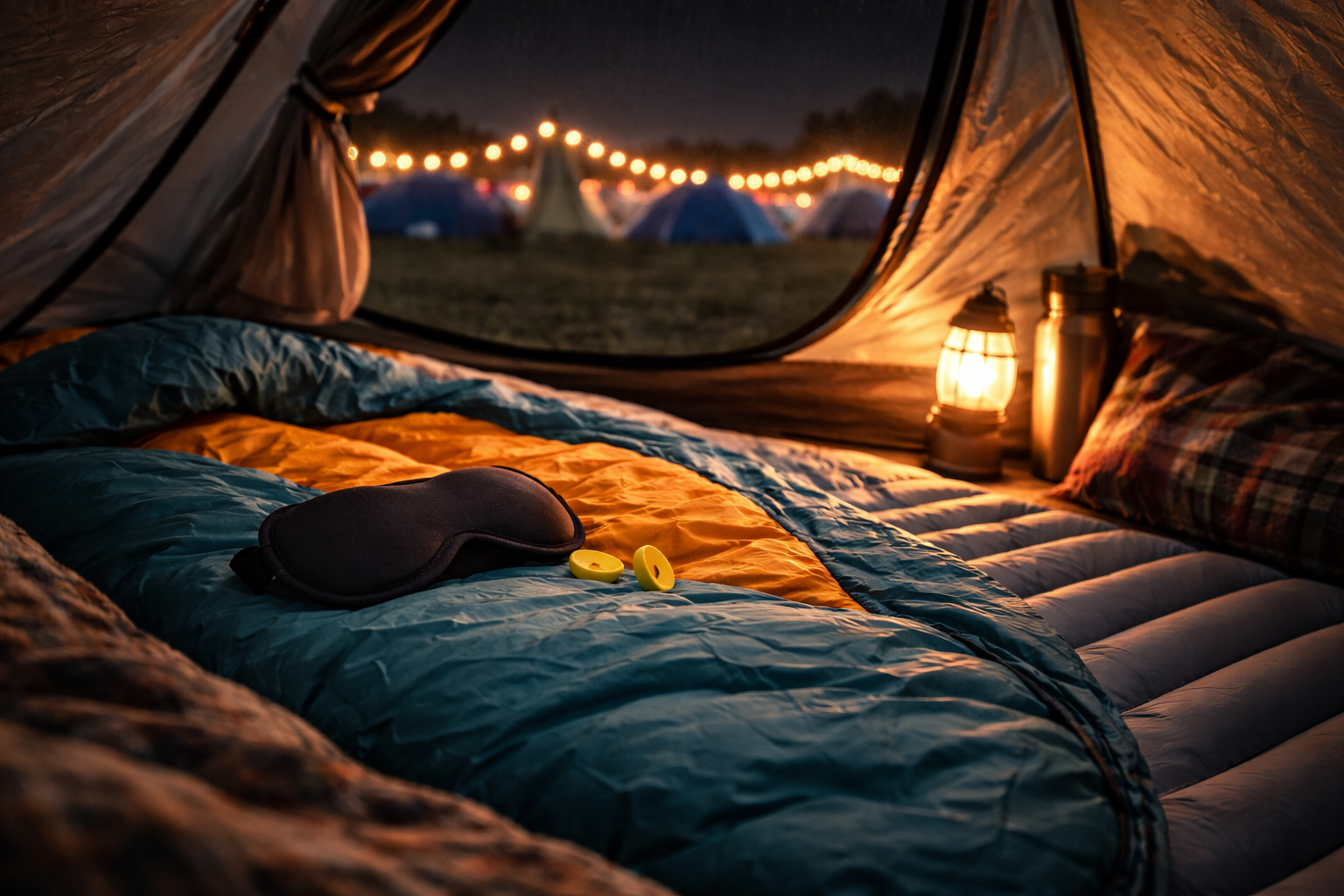
Quick answer: how do you sleep at a festival?
The five things that make the biggest difference: foam earplugs (NRR 32+), a contoured eye mask, a sleeping mat, a 3-season sleeping bag rated to 5°C or lower, and a camping pillow. Pitch away from main walkways and late-night areas. Vent your tent before sleeping. Take magnesium and 5-HTP in the evening to support your body’s natural sleep systems. Protect at least one or two nights by returning to camp before 1am — the cumulative sleep debt from four consecutive 4am nights is genuinely hard to recover from by Sunday.
Here is the honest truth about sleep at a UK festival: you are not going to get eight hours in a dark, quiet room. The noise, early sunrise, temperature swings, and the pull of staying out until 3am mean that is simply not on the cards. But there is a significant difference between sleeping badly and sleeping so badly you are a hollow shell by day three, watching the Sunday headliner through half-closed eyes.
This guide covers everything that actually makes a difference — the kit, the tactics, and the natural support that helps your body get more out of whatever sleep you do get.
👉 Download our free Festival Survival Guide — includes a full sleep kit checklist alongside everything else you need for a UK camping festival.
Why festival sleep is so difficult
Quick answer: why is it so hard to sleep at a festival?
Five specific factors make festival sleep difficult: constant campsite noise, early sunrise flooding your tent with light, unpredictable temperature, disrupted circadian rhythm from late nights and alcohol, and physical discomfort from sleeping on the ground. None of these are fully solvable — but every single one is significantly improvable with the right preparation. Most festival-goers fix none of them and wonder why they feel terrible by day three.
Understanding what is working against you helps you address each factor properly:
Noise: Festival campsites are never quiet. Generators run through the night, late-night stages pump bass until 2–3am, neighbours return at 4am, and the ambient noise of thousands of people camping nearby creates a constant background hum. Even when it is relatively quiet, irregular sounds — a tent zip, a dropped bottle, a laughing group walking past — repeatedly break your sleep cycles.
Light: UK summer mornings are brutal for sleep. In June, sunrise is around 4:30–5:00am. Without blackout fabric, your tent becomes uncomfortably bright and hot far earlier than your body wants to wake up. Most standard festival tents with thin pale fabric are effectively unusable past 5am on a sunny morning.
Temperature: Tent temperatures are wildly variable. A tent left closed in afternoon sun can reach 40°C+ by mid-afternoon. By 2–3am, the same tent can be genuinely cold. Getting both ends of this right requires the right kit — particularly a sleeping mat and appropriately rated sleeping bag.
Disrupted circadian rhythm: Your body’s sleep-wake cycle is regulated by cortisol (rises in the morning), melatonin (rises in the evening), and body temperature. Later nights, more alcohol than usual, irregular eating, and high physical activity throw all three out of sync. After the first night, your natural melatonin timing gets progressively more disrupted — making it harder to fall asleep even when you are exhausted.
Ground discomfort: Sleeping without a mat on the bare ground is genuinely bad for sleep quality and your back. The ground conducts cold through any sleeping bag, and the hard surface causes pressure points that wake you repeatedly through the night. A sleeping mat is not optional — it is the foundation of everything else.
The non-negotiable sleep kit
Earplugs — the single highest-impact item
Quick answer: what earplugs are best for sleeping at a festival?
For sleeping at a festival, foam disposable earplugs with an NRR rating of 32–33dB provide the best noise reduction available. They block enough ambient noise to make a real difference to sleep onset and depth. Reusable silicone earplugs are more comfortable for some people but offer slightly less reduction. Pack both types — foam for the noisiest nights, silicone for general use. Carry at least four pairs of foam earplugs for a four-day festival — they get lost, damaged, or lent to friends.
Earplugs are the highest return-on-investment sleep item at a festival by a significant margin. They cost almost nothing, weigh almost nothing, and the difference between trying to sleep in a noisy festival campsite with and without them is genuinely substantial.
- Foam disposable earplugs (NRR 32–33dB): maximum noise reduction, need to be rolled and inserted correctly to work — take a moment to do this properly. Browse foam earplugs bulk pack on Amazon
- Reusable silicone earplugs: more comfortable for all-night wear, slightly less reduction. Good for lighter sleepers or those who find foam uncomfortable. Browse reusable silicone earplugs on Amazon
- Wax earplugs: moulds to your ear canal shape, extremely comfortable, good reduction — worth trying if foam irritates your ears. Browse wax earplugs on Amazon
See our full guide to the best earplugs for concerts and festivals UK for specific recommendations across every type.
Eye mask — underrated and essential
Quick answer: does an eye mask actually help sleep at a festival?
Yes — significantly. A contoured eye mask blocks the early morning sunlight that floods a standard festival tent by 5am, and research consistently shows that light exposure is one of the strongest signals to your brain to stop producing melatonin and wake up. Without an eye mask, you are fighting your own biology every morning. With one, you can realistically get an extra hour or two of sleep that makes a measurable difference to how you feel across the weekend.
A contoured sleep mask that does not press directly onto your eyelids is more comfortable for all-night wear than a flat mask. Pack it in your day bag so it is ready to go when you return to the tent. Browse contoured sleep masks on Amazon — good options from under £10.
Sleeping mat — not optional
Quick answer: do I need a sleeping mat at a festival?
Yes — a sleeping mat is essential, not optional. Sleeping bag temperature ratings assume you are insulated from the ground. Without a mat, cold conducts straight up through your sleeping bag from the ground — regardless of how warm your bag is rated. A sleeping mat also provides the cushioning your body needs to sleep without waking from pressure points. Even a basic closed-cell foam roll mat for £8 makes a significant difference over nothing.
For festivals, the practical choices are:
- Foam roll mat (closed-cell): inexpensive (~£8–£15), indestructible, cannot deflate. Least packable but lightest and most reliable. Strap to the outside of your rucksack. Browse foam roll mats on Amazon
- Self-inflating mat: more comfortable and more packable than foam (~£20–£60). Good festival choice. Browse self-inflating mats on Amazon
- Inflatable mat: most comfortable, most packable, but can puncture. Bring a repair kit. Better for dry festivals with low puncture risk. Browse inflatable sleeping mats on Amazon
The right sleeping bag
Quick answer: what sleeping bag do I need for a festival?
A 3-season sleeping bag with a comfort rating of 5°C or lower covers the full UK festival season safely. UK festival nights regularly drop to 5–8°C even in July — a summer bag rated only to 10°C comfort will leave you cold by 3am. Being cold is one of the most effective ways to prevent deep sleep. See our full guide to the best festival sleeping bags UK for specific picks at every price point.
Camping pillow
Quick answer: should I bring a camping pillow to a festival?
Yes — sleeping without a pillow contributes to neck stiffness that compounds across a multi-day festival. An inflatable camping pillow packs down to almost nothing and adds significant comfort. The DIY alternative: stuff a fleece or clean t-shirt into a pillowcase. Browse inflatable camping pillows on Amazon — good options from around £8.
Tent choice and setup for better sleep
Quick answer: what is the best tent for sleeping at a festival?
A tent with a blackout inner fabric makes the single biggest difference to how long you can sleep in the morning. Decathlon’s Quechua blackout tent range blocks up to 99% of light, meaning 5am sunrise does not wake you. If you are buying a new tent before a festival, blackout fabric is worth prioritising above almost everything else for sleep quality. See our guide to the best camping tents for UK festivals for specific blackout tent picks.
Tent setup tips for better sleep:
- Door orientation: pitch with the door facing away from the rising sun (facing west or northwest) to reduce early morning light penetration even in a non-blackout tent
- Ventilation: open vents or leave the door slightly unzipped when sleeping — condensation and CO2 build up in a sealed tent overnight, and a cooler fresher tent helps you sleep more deeply
- Daytime heat management: open all vents and doors during the day when you are not in the tent, or drape a reflective emergency blanket over the outside to reduce heat absorption. Browse reflective emergency blankets on Amazon. A tent baking at 40°C all afternoon takes hours to cool down and makes falling asleep much harder
- Groundsheet: a good groundsheet or footprint under your tent reduces ground cold penetration and moisture, improving the sleeping environment further. Browse tent groundsheets on Amazon
Campsite sleep tactics that actually work
Choose your pitch wisely
Quick answer: where is the best place to pitch for better sleep at a festival?
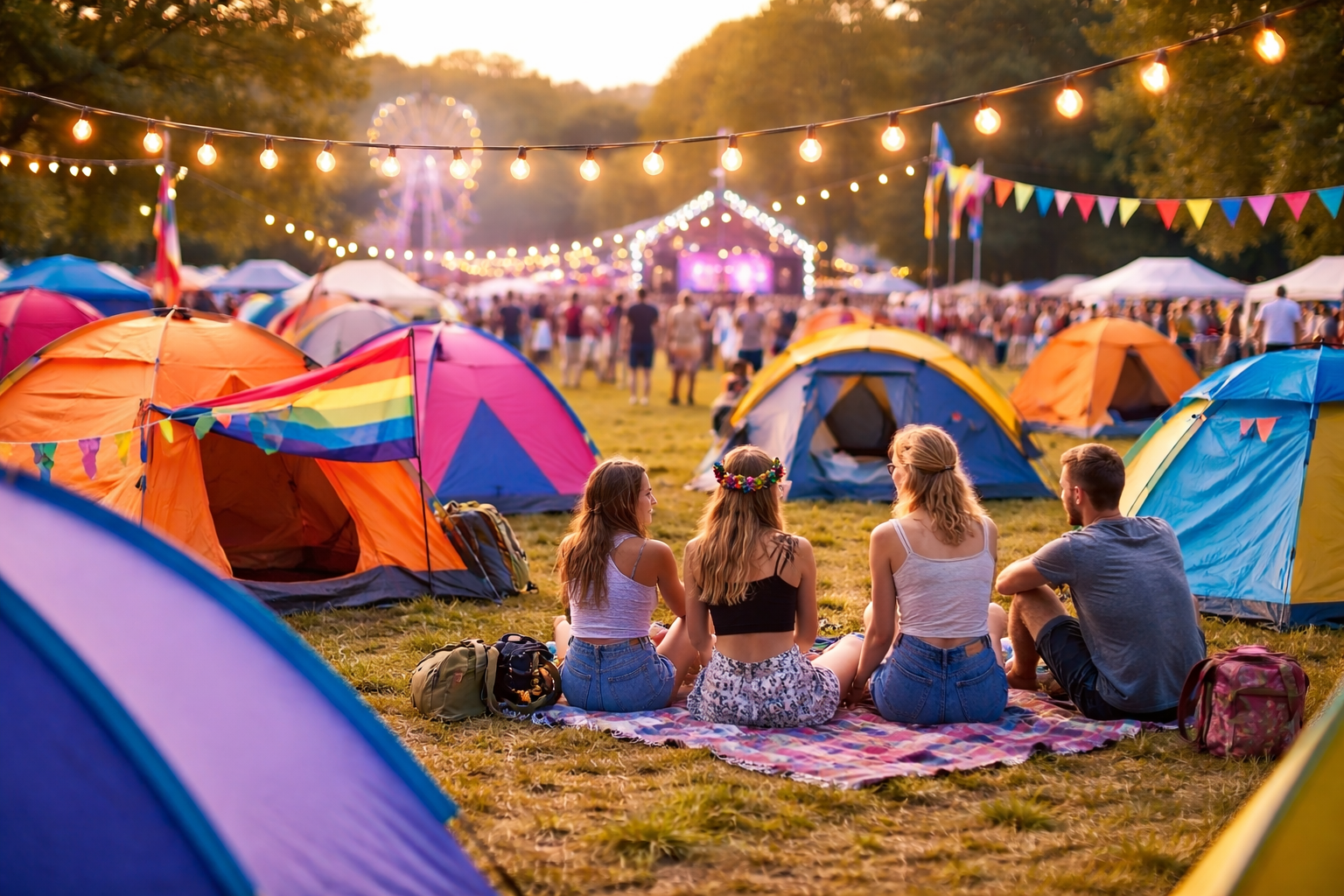
Pitch as far from main pathways, late-night areas, and generators as possible. Find a spot away from the main flow of people returning from stages in the early hours. Silent discos, late bars, and 24-hour areas create noise long after main stages close — check the site map before pitching. Arriving early enough to have a genuine choice of pitch is one of the best free sleep improvements available. The quieter fringes of a campsite are almost always better for sleep than the high-traffic central areas.
Protect your sleep window
Quick answer: how many hours of sleep do I need at a festival?
Even four to five hours of genuine sleep per night is significantly better than two or three, and the difference shows clearly by day three. The most effective single tactic for festival sleep is choosing one or two nights per weekend to return to camp at midnight or 1am rather than 4am. You miss the last hour or two of a late stage, but you gain two to three extra hours of sleep that make a measurable difference to how you feel the next day. Sunday headliners are enjoyed most by people who managed their sleep across the weekend — not those who went all-out every night.
Your pre-sleep routine
A brief wind-down routine signals to your body that sleep is approaching — even in a festival environment:
- Get back to the tent, change into your dedicated sleep layer (not the clothes you wore all day)
- Drink a full water bottle — hydration before sleep reduces morning headaches and partially offsets alcohol disruption
- Take your evening supplements (magnesium, 5-HTP) if using them
- Sip chamomile tea if you packed it — genuinely mild but effective as a wind-down signal
- Fit your earplugs and put on your eye mask before lying down
- Vent the tent before zipping up
This whole routine takes five minutes. It is not glamorous, but the consistency of doing it creates a genuine sleep signal that helps your disrupted circadian rhythm.
White noise
Quick answer: does white noise help with festival sleep?
Yes — a white noise app on your phone playing through one earbud alongside your earplugs is genuinely effective for many people. The consistent background sound masks the irregular, unpredictable campsite noises (a shout, a tent zip, footsteps) that break sleep cycles most effectively. The brain habituates to consistent sounds far more easily than to random ones. Apps like Rain Rain, White Noise Lite, or simply a brown noise YouTube video work well. Make sure your phone is on low brightness to avoid disrupting your eye mask strategy.
Thermal base layers to bed
A thin merino wool or synthetic thermal top and bottoms adds several degrees of effective warmth and is far more comfortable than sleeping in regular festival clothes that bunch up and restrict movement. Keep a dedicated sleep layer clean and separate from your daytime kit — putting on clean, dry thermals before sleep is one of the small comfort upgrades that makes a disproportionate difference. Browse thermal base layers on Amazon. A beanie hat to sleep in also helps significantly — your head loses substantial body heat, and even with a mummy bag hood, a hat provides extra insurance on cold nights.
Natural sleep support at festivals
Quick answer: are there supplements that help with sleep at a festival?
Yes. Magnesium, 5-HTP with L-Tryptophan, and chamomile are the three most practically useful sleep support supplements for festival conditions. Magnesium supports muscle relaxation and nervous system regulation — particularly depleted by alcohol and physical activity. 5-HTP supports natural serotonin production which underpins melatonin and sleep quality. Chamomile is a mild and well-evidenced herbal sedative. None of these force sleep — they support the conditions your body needs to sleep better naturally.
Festival conditions are exactly the circumstances that deplete the nutrients your body uses to regulate sleep. Disrupted routine, more alcohol, late nights, and high physical activity all work against your natural sleep systems. A small amount of preparation makes a real difference.
5-HTP and L-Tryptophan
5-HTP (5-Hydroxytryptophan) is a naturally occurring amino acid that your body converts into serotonin — the neurotransmitter that regulates mood, appetite, and sleep. Serotonin is the precursor to melatonin, the hormone that signals sleep onset. When serotonin is well-supported, your body’s natural melatonin production is more effective — helping you fall asleep more readily even in a disrupted environment.
L-Tryptophan is another amino acid that also converts to serotonin via a parallel pathway. Together, they provide complementary support for the same system.
Lily & Loaf’s 5-HTP with L-Tryptophan combines both amino acids in a clean, non-drowsy formula that works with your body’s natural sleep chemistry. Take as part of your evening routine in the days before and during your festival. Always read the label — 5-HTP should not be combined with SSRIs or certain medications. Consult your GP if you are on any medication.

Magnesium
Quick answer: does magnesium help with sleep at a festival?
Yes — magnesium plays a key role in nervous system regulation, muscle relaxation, and the production of GABA, the inhibitory neurotransmitter that quiets brain activity and enables sleep. It is commonly depleted by alcohol consumption and high physical activity — both festival staples. Low magnesium contributes to restlessness, muscle cramps, and difficulty falling asleep. Taking magnesium in the evening is one of the most straightforward and well-evidenced natural sleep support additions available.
Lily & Loaf’s magnesium range includes Double Magnesium and Triple Magnesium in travel-friendly capsule formats — easy to pack in a wash bag alongside your other festival kit.

Chamomile and herbal wind-down
Chamomile contains apigenin — a compound that binds to benzodiazepine receptors in the brain and produces a mild sedative effect. It is one of the few herbal sleep remedies with genuine clinical backing. A chamomile tea bag in your kit costs almost nothing, takes up no space, and provides a useful evening wind-down signal that works both psychologically and biochemically. Pack five or six bags — one per evening plus spares. Browse chamomile tea bags on Amazon.
Caffeine management
Quick answer: how does caffeine affect sleep at a festival?
Caffeine has a half-life of five to seven hours — a coffee at 4pm means half of it is still active in your system at 9–11pm. At a festival where you are already fighting noise, light, and disrupted routine, adding caffeine to the mix makes falling asleep significantly harder. Switch to herbal tea or water after 2pm. Energy drinks are particularly problematic — many contain 150–200mg of caffeine plus additional stimulants that compound the sleep disruption.
Alcohol and hydration
Alcohol disrupts sleep architecture significantly — it may help you fall asleep initially but reduces REM sleep, causing you to wake earlier and feel less rested. Staying well-hydrated partially offsets some of the sleep-disrupting effects of alcohol. Drink a full water bottle before getting into your sleeping bag. Adding an electrolyte tablet to the water is better still — replacing the sodium, potassium, and magnesium lost through alcohol metabolism. Browse electrolyte tablets on Amazon or check Lily & Loaf’s electrolyte range.
Blocking noise at a festival
Quick answer: how do I block out noise at a festival campsite?
The most effective approach combines three layers: (1) earplugs (foam NRR 32+ for maximum reduction), (2) strategic pitch placement away from noise sources, (3) white noise app to mask irregular sounds. No single solution blocks all festival noise — the three-layer approach addresses different noise types. Earplugs handle continuous ambient noise. Strategic pitching reduces the volume of intrusive sounds before they reach you. White noise masks the unpredictable irregular sounds that break sleep cycles most effectively.
Noise sources at festival campsites
- Late-night stages and silent discos: check the site map and pitch as far as possible from these areas
- Generators: often running 24 hours near welfare, medical, and catering areas — avoid pitching near obvious generator areas
- Main walkways: the high-traffic routes between campsites and stages stay busy until 4–5am — pitch at least 50 metres from any main path
- Neighbouring campers: unavoidable, but positioning your tent with its entrance facing away from your neighbours reduces sound penetration
- Early morning traffic: people packing up, going to the toilet, or simply waking early — a reality of all festival camping that earplugs address best
Managing temperature in your tent
Quick answer: how do I control the temperature in my festival tent for sleep?
Address both extremes: daytime heat (keep the tent open and ventilated all day while you are out) and night cold (sleeping mat + 3-season sleeping bag + thermal base layer). A reflective emergency blanket draped over the outside of your tent during the day dramatically reduces heat absorption. At night, vent the tent slightly rather than sealing it completely — fresh cool air improves sleep quality and reduces condensation.
Temperature management checklist:
- Open all tent vents and unzip the door while out during the day
- Use a reflective tarp or emergency blanket over the tent to reflect sun during peak afternoon heat
- Sleep with vents open or door slightly unzipped — always balance ventilation against warmth
- Use a sleeping mat rated for the ground temperature, not just air temperature
- Keep a sleeping bag liner available to add warmth on unexpectedly cold nights without needing a different bag. Browse sleeping bag liners on Amazon
- Sleep with a thermal base layer and consider a beanie for cold nights
The complete festival sleep kit checklist
| Item | Why it matters | Budget option |
|---|---|---|
| Foam earplugs (4+ pairs) | Blocks campsite noise — highest impact item | Bulk pack ~£3 on Amazon |
| Contoured eye mask | Blocks early morning light (5am sunrise in June) | ~£8–£12 on Amazon |
| Sleeping mat (foam or self-inflating) | Insulates from ground cold — non-negotiable | Foam roll mat ~£8 on Amazon |
| 3-season sleeping bag (5°C comfort) | Warmth on cold UK festival nights | Highlander Hawk 300 ~£30 |
| Inflatable camping pillow | Neck support and sleep comfort | ~£8–£15 on Amazon |
| Thermal base layer (dedicated sleep set) | Warmth without bulk, stays clean | ~£15–£25 on Amazon |
| Beanie hat | Reduces heat loss through head on cold nights | Already packing one |
| 5-HTP + L-Tryptophan | Supports natural serotonin and melatonin | Lily & Loaf sleep range |
| Magnesium (evening) | Muscle relaxation, nervous system regulation | Lily & Loaf magnesium range |
| Chamomile tea bags (x6) | Caffeine-free evening wind-down | ~£1–£2 on Amazon |
| Water bottle (full at bedtime) | Hydration offsets alcohol sleep disruption | Already packing one |
| Electrolyte tablets | Replaces minerals lost through alcohol | ~£4–£8 on Amazon |
| Sleeping bag liner (optional) | Adds 3–8°C warmth to any bag | ~£15–£20 on Amazon |
| White noise app (on phone) | Masks irregular campsite sounds | Free app |

Rest well, play hard
Sleep at a festival will never be perfect. But with the right kit packed, a sensible approach to timing, and some natural support for your body’s sleep systems, you can wake up on Sunday morning feeling ready for one more day. Pack your earplugs, take your supplements, protect at least one early night, and get the most out of every hour you spend in that sleeping bag.
For the complete festival kit list beyond sleep: our free Festival Survival Guide covers everything from gear to food to safety. See you in the field. 🎸
Related reading
- 🎧 Best Earplugs for Concerts and Festivals UK
- 🛏️ Best Festival Sleeping Bags UK
- ⛺ Best Festival Tents UK
- 🎒 Festival Packing List UK
- 🍔 Festival Food Guide UK
- 💪 Best Festival Sleeping Bags UK
Frequently asked questions
How do you get sleep at a festival?
The most effective combination: foam earplugs, a contoured eye mask, a sleeping mat, a 3-season sleeping bag rated to at least 5°C, and a camping pillow. Pitch away from main pathways and late-night zones, vent your tent before sleeping, take magnesium and 5-HTP in the evening, and protect at least one or two nights by returning to camp before 1am.
What is the best thing to bring to sleep at a festival?
Earplugs are the single highest-impact sleep item — they cost almost nothing and make a significant difference to how quickly you fall asleep in a noisy campsite. A contoured eye mask is the second most important, blocking the early morning light that wakes you far too early. After those two, a sleeping mat and a properly rated sleeping bag complete the essential kit.
Is it worth sleeping at a festival?
Absolutely. Even four to five hours of quality sleep per night is significantly better than two or three, and makes a real difference to your energy and enjoyment across the full weekend. The festival-goers who enjoy all four days most are usually those who pace themselves with sleep rather than running out of energy by Saturday afternoon.
How do I block out noise at a festival campsite?
Foam earplugs with NRR 32–33dB provide the most effective noise reduction. Pitch away from main walkways, generators, and late-night areas. A white noise app playing through one earbud alongside earplugs masks the irregular sounds that break sleep cycles most effectively.
How do I stay warm at night at a festival?
Use a sleeping bag with a comfort rating of at least 5°C. Always use a sleeping mat — it insulates you from the ground cold that your sleeping bag rating assumes you are protected from. Sleep in a thermal base layer. Wear a beanie hat to bed. A sleeping bag liner adds 3–8°C of warmth to any bag for around £15.
What supplements help with sleep at a festival?
Magnesium supports muscle relaxation and nervous system regulation — depleted by alcohol and physical activity. 5-HTP with L-Tryptophan supports natural serotonin and melatonin production. Chamomile tea is a mild and well-evidenced herbal sedative. All three work with your body rather than forcing sleep, and are available in compact, travel-friendly formats.
Should I bring earplugs to a festival?
Yes — always. Pack at least four pairs of foam disposable earplugs for a four-day festival. They cost almost nothing and are the single most effective thing you can do for sleep quality at a festival campsite.
What time should I go to sleep at a festival?
There is no single right answer, but protecting at least one or two nights where you return to camp by midnight or 1am makes a significant difference to how you feel across the whole weekend. Four consecutive nights until 4am creates a cumulative sleep debt that is genuinely difficult to recover from by Sunday.
Does alcohol affect sleep at a festival?
Yes — significantly. Alcohol may help you fall asleep initially but reduces REM sleep quality and causes earlier waking. Drinking a full water bottle with an electrolyte tablet before sleep partially offsets the dehydration that compounds alcohol’s sleep disruption. Avoiding alcohol in the last hour before sleeping also helps.
What is the best tent for sleeping at a festival?
A tent with a blackout inner fabric makes the biggest difference to how long you can sleep in the morning. The Decathlon Quechua blackout range blocks up to 99% of light. Pitch with the entrance facing away from the sunrise direction. See our guide to the best festival tents UK for specific blackout tent picks.
Discover more from The Mosh Manual
Subscribe to get the latest posts sent to your email.
13 thoughts on “How to Sleep at a Festival: Actually Get Rest and Wake Up Ready”