

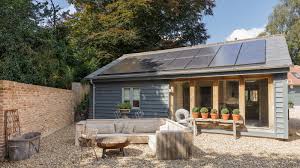
Quick answer: how do I power a cabin or static caravan with solar in the UK?
A static caravan or off-grid cabin needs 2,000–5,000Wh of storage and 400–1,600W of solar input for comfortable daily essential use in the April–October window. The practical all-in-one route: a Bluetti AC200L (2,048Wh) paired with two to four 220W panels covers lighting, refrigeration, device charging, and occasional cooking loads throughout summer with daily solar recharging. For winter, supplement with off-peak grid charging or a small generator. This guide covers every configuration from a weekend cabin to a permanent off-grid static caravan.
An off-grid cabin or static caravan is the most satisfying solar application there is — you own the land, you need the power, and there is no grid alternative. What follows is the practical, honest guide based on UK conditions: lower sun hours than Spain, wetter winters, and a grid that may or may not be worth connecting to depending on your location and usage patterns.
For the complete home solar guide covering all setups, see our home solar power UK guide.
What you actually need to run a cabin or caravan
Quick answer: how much solar do I need to power a static caravan?
A typical static caravan or small off-grid cabin consuming 3–5kWh per day needs approximately 800–1,600W of solar panels and 2,000–5,000Wh of storage for April–October sufficiency. In UK summer, 800W of south-facing panels generates approximately 3,000–4,000Wh on a good day — enough to meet daily needs and recharge storage. In winter, solar alone is insufficient in most UK locations and requires grid or generator supplementation.
Cabin power consumption — typical daily loads
| Appliance | Wattage | Hours/day | Daily Wh | Solar viable? |
|---|---|---|---|---|
| 12V LED lighting (whole cabin) | 30–50W | 5h | 150–250Wh | ✅ Yes |
| 12V compressor fridge | 30–45W avg | 24h | 720–1,080Wh | ✅ Yes (2kWh+ storage) |
| Laptop + devices | 60W | 6h | 360Wh | ✅ Yes |
| Router / internet | 10W | 24h | 240Wh | ✅ Yes |
| Small TV (32″) | 40W | 3h | 120Wh | ✅ Yes |
| Phone and tablet charging | 30W | 2h | 60Wh | ✅ Yes |
| Travel kettle (500W) | 500W | 0.3h | 150Wh | ✅ Yes |
| LPG hob (electricity for ignition) | 5W | 0.5h | 2.5Wh | ✅ Yes |
| Total essentials (no heating) | ~1,800–2,300Wh/day |
System configurations by cabin size
Quick answer: what solar system do I need for a weekend cabin?
A weekend cabin (2–4 people, basic essentials) needs approximately 2× 220W panels + 2,000Wh storage for April–October. This covers lighting, fridge, all device charging, and occasional cooking loads. For a full-time off-grid cabin, scale up to 4× 400W panels and 4,000–6,000Wh of expandable storage.
| Cabin type | Daily consumption | Recommended panels | Recommended storage | System cost (approx.) |
|---|---|---|---|---|
| Weekend retreat (basics only) | 1,000–1,500Wh | 2× 220W = 440W | 2,000Wh (EcoFlow DELTA 2 Max) | ~£1,800–£2,200 |
| Regular use cabin | 2,000–3,000Wh | 4× 220W = 880W | 3,000–4,000Wh (expandable) | ~£2,800–£3,800 |
| Static caravan (year-round) | 3,000–5,000Wh | 4× 400W = 1,600W | 4,000–6,000Wh expandable | ~£3,500–£5,500 |
| Full off-grid home | 5,000–8,000Wh | 6–8× 400W = 2,400–3,200W | 8,000–12,000Wh | ~£6,000–£10,000+ |
Weekend cabin build — recommended kit
- 2× EcoFlow 220W Bifacial panels (~£500–£700)
- 1× EcoFlow DELTA 2 Max 2,048Wh station (~£1,100–£1,400)
- MC4 Y-branch parallel connectors — Amazon
- Adjustable panel tilt stands — Amazon
Regular cabin build — recommended kit
- 4× EcoFlow 220W Bifacial panels (~£1,000–£1,400)
- 1× Bluetti AC200L 2,048Wh (~£1,200–£1,500)
- 1× Bluetti B300K 3,072Wh expansion battery (~£700–£900)
- Panel mounting frames — Amazon
Static caravan solar — specific considerations
Quick answer: can I run a static caravan entirely on solar?
Yes for April–October. No for year-round without supplementation in most UK locations. A static caravan without mains power needs 1,600W of panels and 4,000–5,000Wh of storage minimum for comfortable summer living. The key static caravan constraint is that most units include 240V AC appliances (standard fridge-freezer, microwave, TV) — you need a power station with 2,000W+ AC output and sufficient capacity to run these loads. A 12V LED lighting conversion dramatically reduces evening consumption.
Static caravan — what to upgrade first
- Replace lighting with 12V LED: standard 240V bulbs waste enormous power. 12V LED lighting runs directly from a 12V battery without inverter conversion losses. Browse 12V caravan LED lighting on Amazon
- Replace 240V fridge with 12V compressor fridge: a 12V compressor fridge (Alpicool, Dometic) draws 30–45W on average versus 100–150W for a standard 240V fridge-freezer. Browse 12V compressor fridges on Amazon
- Replace electric kettle with travel kettle (500W): a standard UK kettle draws 2,500–3,000W — incompatible with most portable stations. A 500W travel kettle is fine on any 500W+ inverter
- Switch to LPG for cooking and heating: gas for cooking and space heating eliminates the two biggest electrical loads in a static caravan
The UK winter problem — honest advice
Quick answer: can I live off-grid in the UK in winter on solar alone?
Technically possible but practically challenging without a backup. December and January in the UK deliver an average of 1–2 peak sun hours per day across most of the country. A 1,600W array generates just 1,600–3,200Wh on a good winter day — barely enough to cover essentials for a small cabin, nothing left for storage margin. Most UK off-grid solar users supplement with one of: a small petrol or diesel generator for 2–3 hours of charging per week, off-peak grid charging via Octopus Go if a grid connection is available, or a small wind turbine to complement winter solar.
Winter solar strategy for UK off-grid
| Strategy | Cost | Complexity | Best for |
|---|---|---|---|
| Small backup generator (petrol/diesel) | £150–£500 generator + fuel | Low — run 2–3 hrs/week | Most off-grid cabin owners |
| Off-peak grid charging (Octopus Go) | ~8.5p/kWh overnight | Low — schedule station app | Cabins with mains connection available |
| Small wind turbine | £500–£2,000 installed | Medium — requires mounting, wiring | Windy exposed sites |
| Oversized solar array | Additional panel cost | Low | Sites with good winter sun exposure |
| Reduce winter consumption | Cost of LP gas for heating/cooking | Low — behaviour change | All off-grid users |
For backup generator options: browse quiet inverter generators on Amazon — the inverter type is quieter and more fuel-efficient than conventional generators, and safe to charge LiFePO4 stations via mains socket.
Heating an off-grid cabin — what actually works
Quick answer: how do I heat an off-grid cabin without mains electricity?
The three practical off-grid heating options: (1) Wood burner — the most effective off-grid heat source, no electricity required beyond an optional circulation fan. (2) LPG/propane space heater — efficient, controllable, no electrical requirement. (3) Air source heat pump — most energy-efficient but requires 1–3kW electrical draw, only practical with a large solar system. Electric resistance heating (fan heaters, panel heaters) is not viable for full off-grid solar due to the enormous electrical demand.
Internet and connectivity off-grid
Quick answer: how do I get broadband at an off-grid cabin?
4G/5G mobile broadband is the most practical solution for most UK off-grid cabins — a 4G router with a SIM card from Three, Vodafone, or EE draws only 8–15W and provides fast broadband wherever there is a signal. Elon Musk’s Starlink satellite broadband is the game-changer for remote UK locations without mobile signal — it delivers 50–200Mbps anywhere in the UK and draws approximately 65–100W. A Starlink dish fully powered by solar is an increasingly popular combination. For the most remote locations, a 4G signal booster antenna can extend reach significantly. Browse 4G routers on Amazon and signal booster antennas on Amazon.
| Option | Power draw | Monthly cost | Speed | Requires signal? |
|---|---|---|---|---|
| 4G router (Three/EE/Vodafone) | 8–15W | ~£20–£40 | 20–100Mbps | Yes — 4G coverage needed |
| Starlink Standard | 65–100W | ~£75/month | 50–200Mbps | No — satellite anywhere in UK |
| Starlink Roam (portable) | 65–100W | ~£55/month | 50–150Mbps | No |
| Fixed line (if available) | 8–12W (router) | ~£25–£50 | Up to 1Gbps | N/A — grid infrastructure |
Starlink on solar power
A Starlink Standard dish draws approximately 65–100W continuously — this is a meaningful solar load. On a 2,000Wh storage system running Starlink 24 hours a day, the dish alone consumes approximately 1,800–2,400Wh per day — nearly the entire daily budget. The practical approach: run Starlink during active hours only (8am–10pm, ~14 hours) using a smart plug to cut power overnight. This reduces Starlink consumption to approximately 910–1,400Wh/day. Browse smart plugs on Amazon for Starlink scheduling.
Generator sizing — your winter backup
Quick answer: what size generator do I need for an off-grid cabin backup?
For charging a portable power station (2,000–5,000Wh) from empty: a 2,000W inverter generator runs for 2–4 hours to fully recharge most stations. Station charging draw is typically 800W–1,500W from AC mains input. A 2,000W inverter generator consuming approximately 1 litre of petrol per hour provides 2,000Wh of usable charging per hour of running. For a 5,000Wh system needing a full recharge, that is approximately 3 litres of petrol and 3 hours of running — a very manageable winter supplement routine.
| Generator size | Fuel consumption | Best for | Noise level | Link |
|---|---|---|---|---|
| 1,000W inverter generator | ~0.5–0.7L/hr | Phone + laptop charging only | Low (~53dB) | Amazon |
| 2,000W inverter generator | ~0.9–1.2L/hr | Charging most portable stations | Low (~57dB) | Amazon |
| 3,500W inverter generator | ~1.5–2.0L/hr | Fast charging + running loads simultaneously | Medium (~60dB) | Amazon |
Battery sizing — worked example
Quick answer: how do I calculate what battery size I need?
Step 1: list all appliances and daily hours of use. Step 2: multiply each wattage × hours to get daily Wh. Step 3: sum all daily Wh for total daily consumption. Step 4: multiply by days of autonomy wanted (1.5–2 is typical). Step 5: divide by 0.8 (to avoid 100% depth of discharge daily). The result is your minimum battery capacity in Wh.
Worked example — regular-use UK cabin
| Appliance | Wattage | Hours/day | Daily Wh |
|---|---|---|---|
| 12V LED lighting | 40W | 5h | 200Wh |
| 12V compressor fridge | 40W avg | 24h | 960Wh |
| Laptop + monitor | 65W | 6h | 390Wh |
| 4G router | 12W | 14h | 168Wh |
| Phone charging (×2) | 25W | 2h | 50Wh |
| TV (32″ LED) | 40W | 3h | 120Wh |
| Travel kettle (500W) | 500W | 0.3h | 150Wh |
| Total daily | 2,038Wh |
Battery sizing calculation: 2,038Wh × 1.5 days autonomy = 3,057Wh ÷ 0.8 (DoD) = 3,822Wh minimum battery capacity. A Bluetti AC200L (2,048Wh) + B300K expansion (3,072Wh) = 5,120Wh total — provides approximately 2 days of autonomy with safety margin.
Panel sizing calculation: 2,038Wh daily need ÷ 4 peak sun hours (UK summer average) = 510W minimum panel capacity. Four 220W panels (880W) provides comfortable margin for cloudy days and charging the storage beyond daily use.
Small wind turbines for off-grid UK
Quick answer: is a small wind turbine worth it for an off-grid UK cabin?
For sites with consistent wind exposure (hilltops, coastal, open farmland): yes — wind complements solar perfectly in the UK because the windiest periods are often the least sunny (winter, stormy days). A 400–600W small wind turbine generates meaningful power on days when solar underperforms. For sheltered valley or woodland sites: not worth it — trees and terrain reduce average wind speed below the turbine’s effective generation threshold. Check wind resource for your specific location using the Renewables First UK wind resource tool.
- 400W wind turbine kit (~£150–£300) — entry-level, suitable for light wind sites with 3m/s+ average
- 600W wind turbine (~£250–£450) — better blade efficiency, meaningful output from 4m/s+ average wind
Additional frequently asked questions
Can I power a shed or workshop with solar?
Yes — a small workshop with lighting, battery tools charger, and occasional power tool use is well within the capability of a 400W panel setup and 1,000–2,000Wh storage. Power tools (circular saw 1,200W, drill 500W) draw high wattage briefly — ensure your inverter’s surge rating handles the motor startup current. A 2,000W pure sine wave inverter handles most workshop tools. Browse EcoFlow DELTA 2 on Amazon — 1,800W continuous with 2,700W surge covers the majority of workshop tools.
What is the cheapest way to power an off-grid static caravan?
The budget DIY route: two 200W rigid panels (~£250), a 40A MPPT controller (~£70), two 100Ah LiFePO4 batteries in parallel (~£280), and a 2,000W pure sine wave inverter (~£130) — approximately £730–£900 total for 2,400Wh of storage and 400W solar. Significantly cheaper than all-in-one stations at this capacity. Requires basic electrical wiring knowledge. For step-by-step build instructions see our DIY solar power station build guide.
How do I monitor my off-grid cabin solar system remotely?
All-in-one stations (EcoFlow, Bluetti, Jackery) include Wi-Fi monitoring via smartphone app — view generation, battery state, and consumption from anywhere with mobile signal. For DIY component builds: the Victron Cerbo GX provides professional remote monitoring over mobile data. For basic monitoring, a Bluetooth-enabled MPPT controller (Victron SmartSolar, Renogy BT-enabled) is sufficient for on-site checks during visits.
Water heating off-grid
Quick answer: how do I heat water off-grid?
The best off-grid water heating options: LPG instant water heater (no electricity required, heats on demand) — browse LPG water heaters on Amazon. Solar thermal (separate from PV — pipes heat water directly using the sun, extremely efficient in summer). Immersion heater (3,000W) — only viable if you have surplus solar generation or a large battery; even then it is inefficient. For most UK off-grid cabins, LPG instant water heating is the most practical solution.
Best complete off-grid solar systems
Best all-in-one: Bluetti AC200L + B300K expansion + 4× 220W panels
Total storage: 5,120Wh. Total solar input: 880W. AC output: 2,400W. 3,500 LiFePO4 cycles. Enough for a well-managed regular-use cabin April–October. The B300K expansion battery connects directly to the AC200L — no additional components needed.
Best expandable: Jackery Explorer 2000 Plus + 4× SolarSaga 200W
Total storage: 2,042Wh expandable to 12kWh with add-on batteries. Solar input: up to 1,200W. AC output: 3,000W surge 6,000W. The Jackery Plus ecosystem allows battery expansion over time as budget allows.
Best DIY off-grid: 4× 400W rigid panels + Renogy MPPT + 2× 200Ah LiFePO4 + 3,000W inverter
Total storage: 4,800Wh. Solar input: 1,600W. Cost: approximately £1,500–£2,200 in components — significantly cheaper than all-in-one at this capacity. Requires basic electrical knowledge to wire.
Planning permission for off-grid solar at a cabin
Quick answer: do I need planning permission for solar panels at an off-grid cabin?
For ground-mounted portable panels on your land: no planning permission required. For fixed roof-mounted panels on a permanent cabin structure: permitted development rights apply — no permission needed provided the panels do not protrude more than 200mm from the roof and the building is not listed or in a designated area. For new off-grid static caravans or cabins being installed on land: the structure itself may require planning permission; the solar installation is secondary to this question. Always check with your local planning authority for your specific situation.
Related guides
- ☀️ Home Solar Power UK — complete guide
- 🔧 DIY Solar Power Station Build UK
- 🔋 Octopus Agile Battery Storage Guide
- 🔋 Best Portable Power for Camping UK
Frequently asked questions
How many solar panels do I need to power a static caravan?
For April–October comfortable living: 4× 220W panels (880W total) with 2,000–4,000Wh of storage. For year-round living with winter generator backup: 4× 400W panels (1,600W) with 4,000–5,000Wh storage. A 12V LED lighting conversion and 12V compressor fridge significantly reduce daily consumption and allow a smaller panel array to be sufficient.
What battery capacity do I need for an off-grid cabin?
Size for 1.5–2 days of autonomy without solar input. Calculate your daily Wh consumption (sum of all appliance wattage × hours used), multiply by 1.5–2, then add 20% margin. A typical off-grid cabin consuming 2,000Wh per day needs 3,000–4,000Wh of storage for one day’s autonomy with margin.
Can I run a fridge off-grid in the UK?
Yes — a 12V compressor fridge (Alpicool, Dometic, or equivalent) drawing 30–45W average is entirely manageable on a 2,000Wh+ solar storage system. A standard 240V household fridge-freezer drawing 100–150W is also viable on a larger system (3,000Wh+) but uses significantly more power. The 12V compressor fridge upgrade is the single highest-impact efficiency improvement for most off-grid cabins.
Do I need planning permission for an off-grid cabin with solar panels?
For ground-mounted portable panels: no permission required. For fixed roof panels on a permanent structure: permitted development applies in most cases. The cabin or caravan structure itself is a separate planning question from the solar installation — check with your local planning authority for your specific situation.
Discover more from The Mosh Manual
Subscribe to get the latest posts sent to your email.


One thought on “Off-Grid Solar UK: Cabin and Static Caravan Power Guide 2026”