

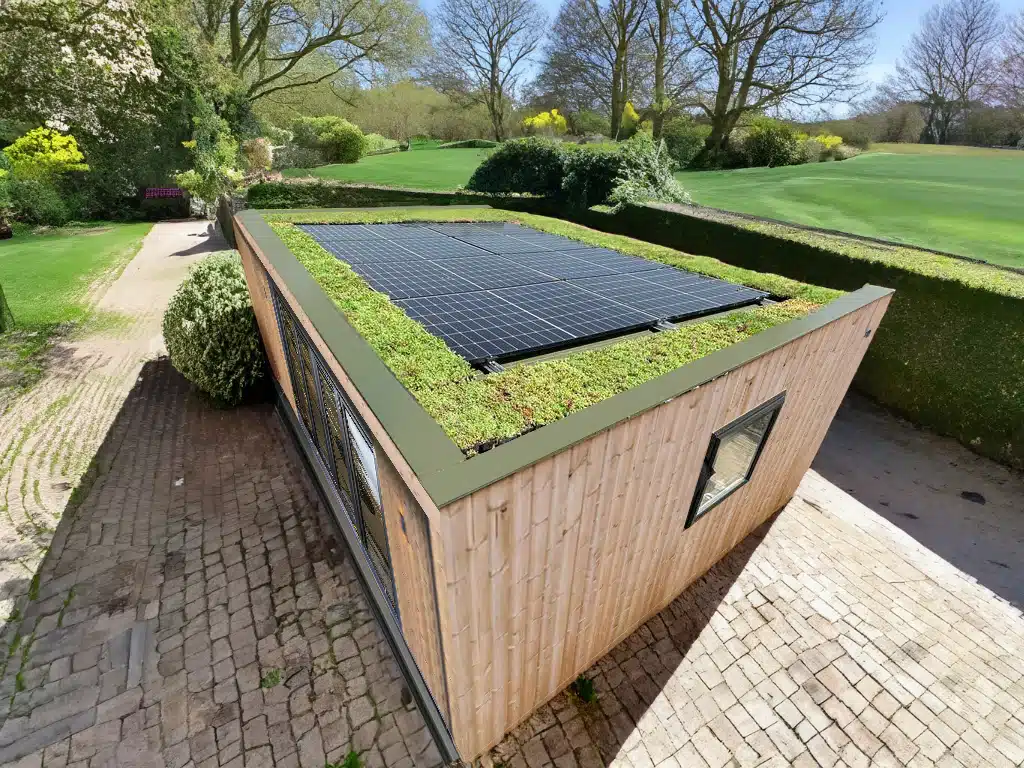
Quick answer: can I power my garden office with solar panels?
Yes — a garden office is one of the most practical and cost-effective home solar applications available. A typical garden office drawing 100–200W during the working day can be powered entirely by solar for most of the year. A single 200W panel and 500Wh power station (~£550–£750) covers a basic office setup (laptop, monitor, router, lighting) on most working days from April through September. A two-panel setup extends coverage into autumn and through cloudy spells. No planning permission, no electrician, no grid connection required.
Remote working has fundamentally changed how garden offices are used. What was once a weekend hobby space is now a daily workplace — and that means reliable, affordable power matters more than ever. Solar is particularly well-suited to garden offices because the peak generation hours (10am–3pm) align almost perfectly with core working hours, creating a natural self-consumption match that maximises the value of every unit of solar electricity generated.
For the complete home solar guide covering every setup, see our home solar power UK guide.
How much power does a garden office use?
Quick answer: how many watts does a garden office use?
A typical single-person garden office consumes approximately 100–200W during active working hours. Breakdown: laptop (30W), external monitor (25W), router (10W), LED lighting (20W), phone and peripheral charging (20W) = approximately 105W continuous. Add a small desk fan in summer (30W) or an electric blanket in autumn (60W on low). The highest-draw items are heating (750–2,000W) and occasional kettle boiling (500–3,000W depending on type).
Garden office daily power consumption
| Appliance | Power draw | Hours/working day | Daily Wh |
|---|---|---|---|
| Laptop (MacBook Air / modern Windows) | 25–40W | 8h | 200–320Wh |
| External monitor (24″) | 20–30W | 8h | 160–240Wh |
| Broadband router | 8–15W | 10h | 80–150Wh |
| LED desk lamp | 8–12W | 4h | 32–48Wh |
| Phone and AirPods charging | 20W | 2h | 40Wh |
| Desk fan (summer) | 25–35W | 4h | 100–140Wh |
| Travel kettle (500W) | 500W | 0.3h (3 boils) | 150Wh |
| Total (no heating) | ~760–1,090Wh |
Sizing your solar system for a garden office
Quick answer: how many solar panels do I need for a garden office?
For a single-person home office (100–150W average draw, no heating): 1× 200W panel + 500–768Wh storage covers most working days April–September. On a good summer day the panel generates 700–900Wh — well exceeding the ~1,000Wh daily draw for a typical 10-hour office day. A second 200W panel adds resilience for cloudy days and extends the viable season into October and March.
| Office setup | Daily consumption | Recommended panels | Storage needed | Season coverage |
|---|---|---|---|---|
| Basic (laptop, router, lights) | ~500–700Wh | 1× 200W | 500–768Wh | April–September |
| Standard (+ monitor, fan, kettle) | ~800–1,100Wh | 2× 200W | 768–1,024Wh | March–October |
| Full (+ occasional heater, printer) | ~1,200–2,000Wh | 4× 200W | 1,500–2,000Wh | February–November |
| Winter-capable (+ consistent heating) | ~2,000–4,000Wh | 4× 400W | 3,000–4,000Wh | Year-round (solar-led) |
Setup configurations by garden office type
The portable setup — best for renters or new garden offices
Quick answer: what is the easiest solar setup for a garden office?
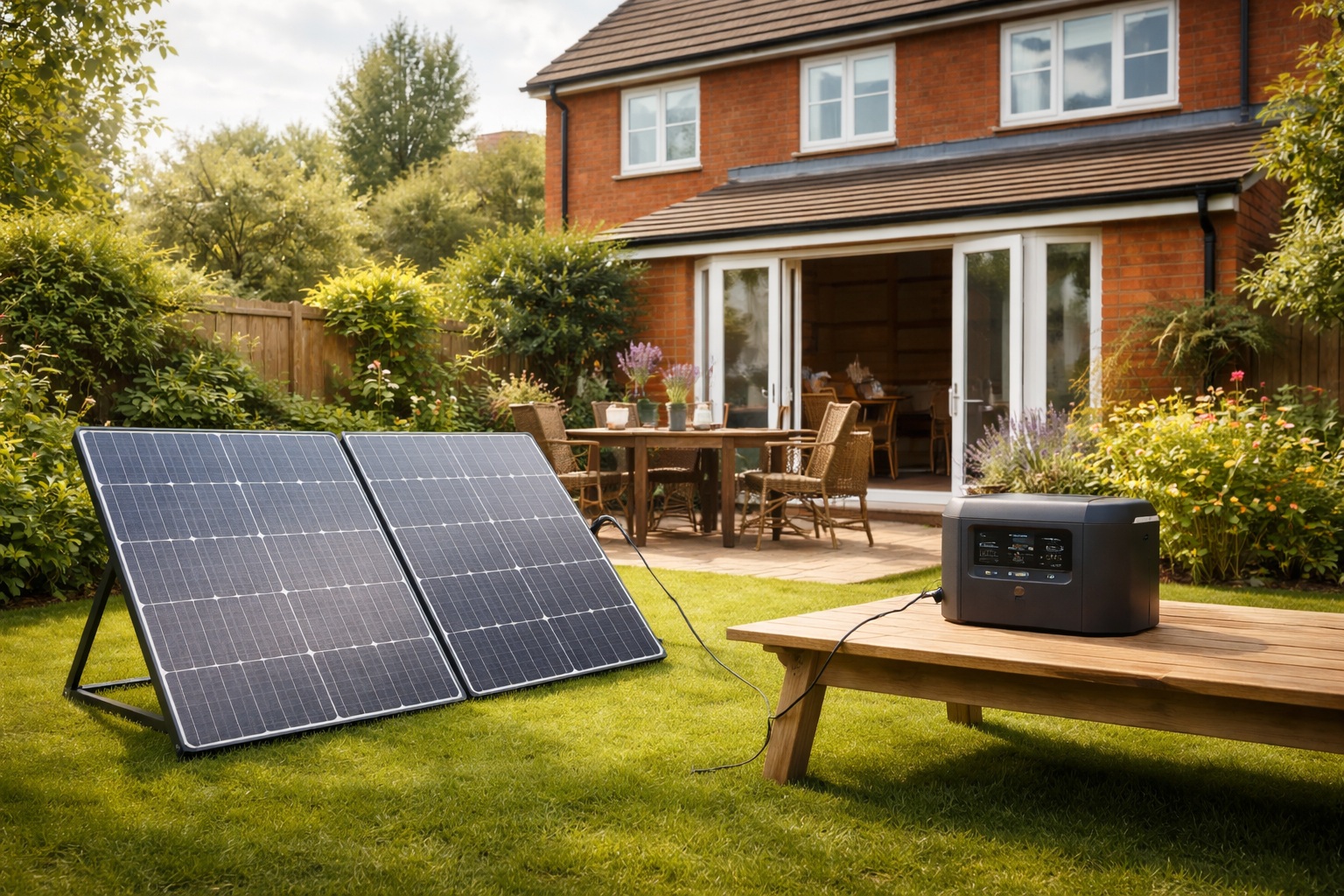
The EcoFlow RIVER 2 Pro (768Wh) plus one EcoFlow 220W Bifacial panel is the perfect starter garden office setup. The panel sits outside on an adjustable stand, plugged into the station via cable through a small gap in the wall or under the door. The station sits on your desk, powering your laptop, monitor, router, and phone from solar electricity — free from the grid during daylight hours. Total cost approximately £600–£750. Works in 20 minutes, no installation required.
The permanent setup — best for year-round garden offices
For a garden office used daily year-round, a fixed installation with rigid roof panels and a larger storage station is more efficient. Options:
- 2× 200W rigid panels on garden office roof + EcoFlow DELTA 2 (1,024Wh) — covers all standard office loads April–October, supplemented by mains in winter
- 4× 200W rigid panels + EcoFlow DELTA 2 Max (2,048Wh) — covers standard office loads plus occasional heating year-round
- DIY build: 2× 200W panels + Renogy MPPT + 100Ah LiFePO4 + 1,000W inverter — permanent, hardwired, approximately £400–£600 in components. See our DIY solar build guide
Best complete systems for garden offices
| Setup | Best for | Kit | Cost approx. |
|---|---|---|---|
| Entry portable | Basic laptop-only office | EcoFlow RIVER 2 Pro + 220W panel | ~£600–£750 |
| Standard portable | Full desk setup, April–Oct | EcoFlow DELTA 2 + 2× 220W panel | ~£1,000–£1,300 |
| Serious portable | Full desk + fan/heater bursts | EcoFlow DELTA 2 Max + 4× 220W | ~£2,000–£2,500 |
| Fixed DIY | Permanent hardwired, budget | 2× 200W rigid + Renogy MPPT + 100Ah LiFePO4 + inverter | ~£400–£600 |
| Premium fixed | Year-round with heating | 4× 400W rigid + Bluetti AC200L + B300K | ~£3,000–£4,000 |
Running a garden office in winter
Quick answer: can I power a garden office with solar in winter?
For device charging and lighting: yes, with a larger panel array. A single 200W panel generates only 130–250Wh on a typical December day — insufficient for a full working day without supplementation. The practical winter strategy: charge the station overnight via mains on Octopus Go cheap-rate electricity (8.5p/kWh) and use solar as a top-up during daylight. This hybrid approach means you are never grid-dependent at expensive peak rates while still using every kWh of solar generated. See our Octopus Agile guide for the full tariff strategy.
Heating your garden office with solar
Quick answer: can I heat a garden office with solar electricity?
In short bursts, yes. In winter sustained heating, no — without a very large system. A 500W low-wattage panel heater running for 4 hours uses 2,000Wh — exceeding what most single-panel setups generate in a full December day. The practical approach: a well-insulated garden office with a small infrared panel heater (250–400W) for edge-season comfort, combined with the solar system covering all other loads. For proper winter heating, propane or LPG is more practical than solar electricity. Browse infrared panel heaters on Amazon.
Solar vs grid connection for garden offices
Quick answer: should I connect my garden office to the grid or use solar?
The honest answer: solar for April–October running costs, grid connection for reliability and winter heating. A grid connection to a garden office (armoured cable, consumer unit, installation) costs approximately £800–£2,000 depending on distance. A solar setup covering 7 months of free electricity costs £600–£1,500 for most office configurations. The two are not mutually exclusive — many garden office owners install both, using solar as the primary source and grid as backup, charged overnight at cheap off-peak rates.
| Factor | Solar only | Grid connection | Solar + grid hybrid |
|---|---|---|---|
| Upfront cost | £600–£2,500 | £800–£2,000 installation | £1,400–£4,500 |
| Annual running cost | Near zero (April–Oct) | Full rate (~£150–£300/yr) | Minimal (cheap overnight rates) |
| Winter reliability | ⚠️ Limited | ✅ Full reliability | ✅ Full reliability |
| Planning/installation | None needed | Electrician + armoured cable | Both |
| Best for | Seasonal use, budget buyers | Year-round daily office, heating needed | Year-round, maximum savings |
Running cables from garden to office — practical guide
Quick answer: how do I get the solar cable from the panel to the power station inside?
Three options depending on your garden office setup: (1) Under the door — the simplest: a flat cable run under a door gap works for a 4mm MC4 solar cable, though a draught excluder may need trimming. (2) Through a wall penetration: drill a 16mm hole, fit a cable gland, run MC4 extension cable through. Browse cable glands on Amazon. (3) Window gap: run cable through a slightly open window with a weatherstrip filler pad. Option 1 requires no tools, option 2 is the most professional, option 3 is fastest for temporary setups.
- 5m MC4 solar extension cable (~£10–£15) — reach from outdoor panel to indoor station
- 16mm cable entry gland (~£5–£10) — weatherproof wall penetration fitting
- Flat cable door/window runner (~£8–£15) — adhesive flat cable run for under-door routing
UPS mode — protecting your work from power cuts
Quick answer: does a power station protect against power cuts?
Yes — power stations with UPS (Uninterruptible Power Supply) mode switch from mains to battery power within milliseconds of a power cut. The EcoFlow DELTA 2 and DELTA 2 Max switch in 30ms — fast enough that computers, routers, and all connected devices continue running without interruption. Your laptop does not restart, your video call does not drop, your cloud sync does not corrupt. A power cut during a working day becomes invisible. This alone justifies having a power station in a garden office even if you never use a solar panel — it is the world’s best UPS for a home office at this price.
To use UPS mode with an EcoFlow station: plug your office equipment into the station’s AC outlets. Plug the station into mains via the included AC charging cable. The station runs everything from mains power, keeping its battery at your set charge level. The instant mains fails, it switches to battery automatically. When mains returns, it switches back and begins recharging. No configuration needed — this is how all EcoFlow DELTA 2 stations work by default.
How insulation affects your solar sizing
Quick answer: does insulation change how much solar I need for a garden office?
Significantly for heated offices. A well-insulated garden office (100mm wall insulation, double glazing) retains heat from a 400W infrared heater for 2–3 hours per heat cycle. A poorly insulated converted shed loses that heat in 30–60 minutes and needs the heater running almost constantly. A £200 insulation upgrade to a shed garden office can halve the heating electrical load — reducing daily solar storage requirements by 1,000–2,000Wh in winter. For any garden office that will be used year-round, insulation investment directly reduces the solar system size needed and is almost always cost-effective.
The insulation vs bigger solar panel maths
| Scenario | Daily heating load (winter) | Extra solar storage needed | Insulation cost |
|---|---|---|---|
| Uninsulated shed (1,500W heater running 4hrs) | 6,000Wh heating | 4× 400W panels + 4,000Wh storage | — |
| Basic insulated (400W infrared, 2hrs cycles) | 1,600Wh heating | 2× 400W panels + 2,000Wh storage | ~£200–£400 |
| Well-insulated (300W panel heater, 1.5hrs cycles) | 900Wh heating | 1× 400W panel + 1,500Wh storage | ~£500–£1,000 |
Dual use — the garden office solar weekend advantage
Quick answer: can I use my garden office solar setup for camping and festivals?
Yes — and this is one of the strongest arguments for the portable station approach versus a hardwired grid connection. The same EcoFlow DELTA 2 that powers your office Monday–Friday goes to a festival on the weekend. You carry it to the car, drive to site, set up the panel, and have power all weekend for charging phones, running a portable speaker, powering lights, and keeping a group fed with a small induction hob. The festival use case improves the cost justification of the system significantly — it stops being “office solar” and becomes “the most useful thing I own.”
For festival and camping power guides that pair perfectly with a garden office solar setup:
- 🎸 Best Portable Power for Camping UK
- ⚡ Best Festival Power Banks UK
- 🏕️ Best Power Bank for Glastonbury 2026
Worked sizing example — real garden office
Scenario: Alan’s garden office. Used Monday–Friday, 9am–5pm. MacBook Pro (45W), 27″ monitor (35W), router (12W), desk lamp (10W), phone charging (20W), afternoon coffee via travel kettle (500W for 3 minutes = 25Wh). Total daily consumption: approximately 950–1,050Wh on a working day.
Summer (April–September) solar generation: one EcoFlow 220W Bifacial panel generates approximately 700–900Wh on an average summer day. On a clear day it covers the full daily load. On a heavily overcast day it provides ~180–220Wh — supplementation needed.
Recommended setup: two EcoFlow 220W Bifacial panels (440W total) + EcoFlow DELTA 2 (1,024Wh storage). On a clear summer day both panels generate ~1,400–1,800Wh — fully charging the station by midday and covering the full working day from solar. On overcast days the station’s stored overnight charge covers the deficit.
Winter strategy: charge the station overnight on Octopus Go (8.5p/kWh, 00:30–05:30) — a full charge from empty costs approximately 8.7p per kWh × 1kWh = 87p for a full day of office power at cheap rate. Solar supplements during daylight hours (100–250Wh on a December day). Total daily winter electricity cost from the office: under £1 for a full working day.
Garden office grid connection — what it actually costs
Quick answer: how much does it cost to connect a garden office to the mains?
A typical garden office mains connection in the UK costs £800–£2,000 depending on cable run distance, trench depth, whether armoured cable goes under a path or patio, and your electrician’s rates. This includes a consumer unit in the office (RCD, MCBs, sockets, lighting circuit). Add another £150–£400 for a dedicated internet cable run alongside it. A solar setup at £600–£1,500 covering 7 months of free power competes well against this on pure cost — and provides the UPS and camping/festival dual-use that a mains connection does not.
Additional frequently asked questions
Can I run two monitors from a garden office solar setup?
Yes — two 24″ monitors draw approximately 40–50W combined. Adding a second monitor increases daily consumption by approximately 240–300Wh on an 8-hour day. A two-panel setup (400–440W) comfortably handles dual monitor setups April–September. For a single-panel setup, dual monitors may push you slightly over daily generation on overcast summer days — the station buffer handles this fine with an overnight charge top-up.
What is the best all-in-one system for a garden office?
The EcoFlow DELTA 2 (1,024Wh, 1,800W AC, 30ms UPS) paired with 2× EcoFlow 220W Bifacial panels covers 95% of garden office use cases. It accepts both solar and mains input simultaneously, has the fastest UPS switchover of any portable station, and the EcoFlow app gives complete monitoring and scheduling control. Browse on Amazon or direct from EcoFlow UK.
Will a garden office solar setup work in an Irish climate?
Yes — Ireland has similar solar resource to Wales and northern England, averaging 850–1,000 peak sun hours per year. A garden office solar setup sized for the UK north (two 220W panels) works well in Irish conditions. The same winter supplementation strategy applies — overnight charging on cheap-rate electricity covers December and January deficits. Ireland’s ESB Networks has its own grid connection rules for solar; consult SEAI (Sustainable Energy Authority of Ireland) for current microgeneration guidelines.
Planning permission for garden office solar
Quick answer: do I need planning permission for solar panels on a garden office?
No — garden office solar panels are permitted development in England provided the panels do not protrude more than 200mm from the roof surface and the building is not listed or in a designated area. Ground-mounted portable panels in the garden require no permission regardless. Always check with your local authority if your property has any protected status.
Related guides
- ☀️ Home Solar Power UK — complete guide
- 🔋 Octopus Agile Battery Storage Guide
- 🔧 DIY Solar Power Station Build UK
- 🏕️ Off-Grid Solar for Cabins and Caravans
- 🔋 Best Portable Power for Camping UK
Frequently asked questions
How much does it cost to solar power a garden office?
A basic setup (1× 200W panel + EcoFlow RIVER 2 Pro) costs approximately £600–£750 and covers a laptop-led office April–September. A full setup (2× 200W panels + EcoFlow DELTA 2) costs approximately £1,000–£1,300 and extends coverage through cloudy days. A year-round setup capable of supplementing heating costs approximately £2,000–£2,500.
Do I need planning permission for solar panels on a garden office?
No — permitted development rights apply to garden office solar panels in England provided they do not protrude more than 200mm from the roof and the building is not listed or in a designated area. Ground-mounted portable panels require no permission.
Can I run a printer from a garden office solar setup?
Yes — a typical laser printer draws 300–500W when printing but only 5–10W on standby. A 500Wh+ power station handles occasional print jobs without issue. Inkjet printers draw significantly less (30–80W). Browse EcoFlow DELTA 2 on Amazon for a 1,000Wh station that covers all standard office loads including printing.
Is solar enough to run a garden office in winter?
For lighting and device charging: yes with a larger array. For sustained heating: no without a very large system. The practical winter strategy is overnight mains charging on Octopus Go cheap-rate (8.5p/kWh) topped up by solar during daylight hours — maximising solar use while ensuring reliability.
What is the best power station for a garden office?
For most garden offices: the EcoFlow DELTA 2 (1,024Wh, 1,800W AC output) at approximately £600–£750. It accepts up to 500W solar input, has built-in UPS mode for power cut protection, and its app allows scheduled charging for off-peak tariff optimisation. Browse EcoFlow DELTA 2 on Amazon.
Discover more from The Mosh Manual
Subscribe to get the latest posts sent to your email.


One thought on “Solar Panels for Garden Office UK 2026: Complete Power Guide From £600”