

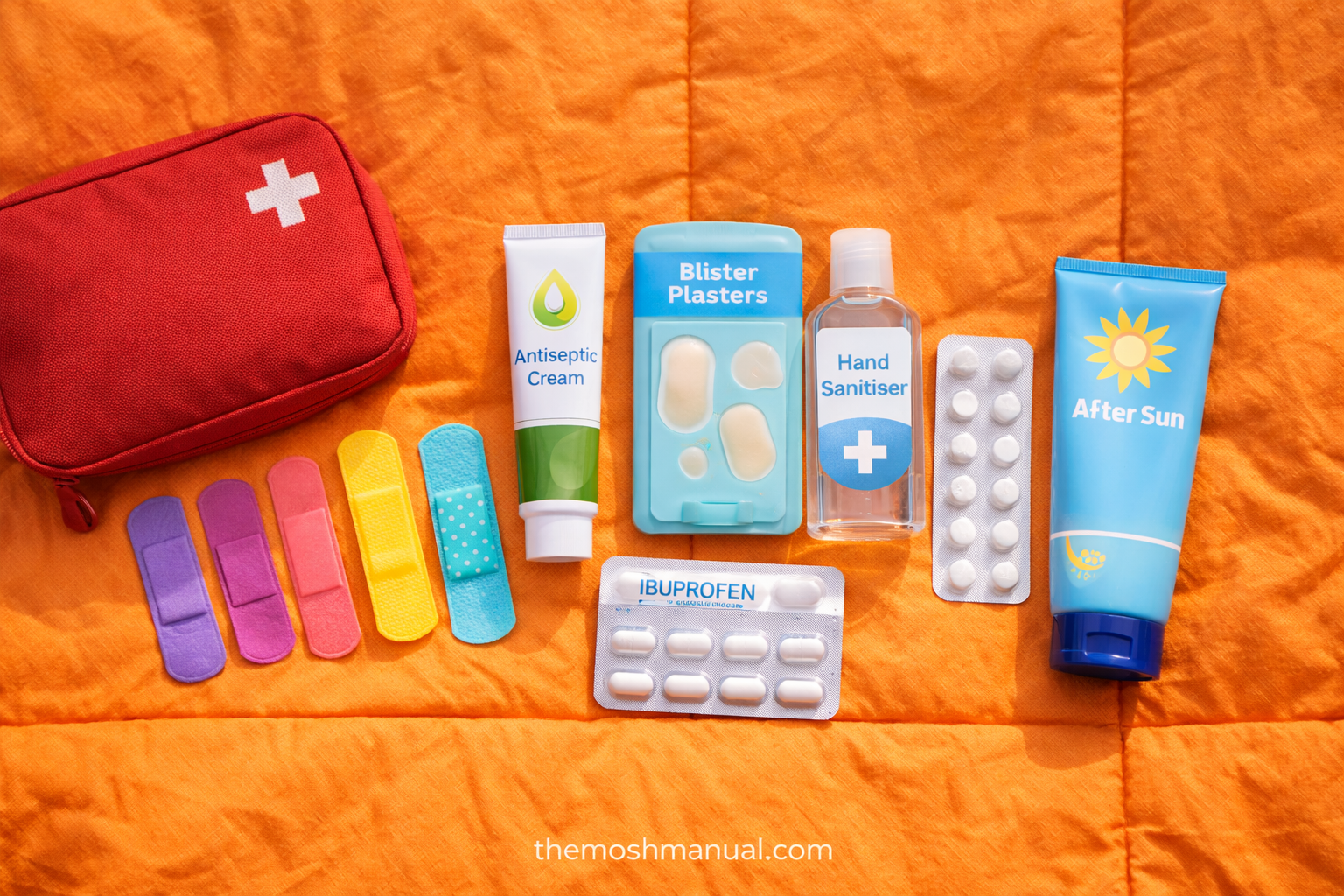
Quick answer: what do I put in a festival first aid kit?
The non-negotiable essentials: hydrocolloid blister plasters (Compeed), assorted waterproof plasters, antiseptic wipes, antiseptic cream, ibuprofen, paracetamol, non-drowsy antihistamine tablets, after sun lotion, oral rehydration sachets, insect repellent, wound closure strips (Steri-Strips), elastic bandage, and blister prevention balm. Pack everything in a waterproof zip pouch — not a cardboard box that disintegrates in the rain. Build your own rather than buying a pre-made kit — pre-made kits consistently miss the festival-specific essentials while including items you will never use.
Every UK festival has a medical tent. Most festival-goers assume that is enough — that if anything goes wrong, help is nearby. And for serious emergencies, that is true. But the medical tent is not there for blisters, sunburn, headaches, or the ankle twist that happens crossing a muddy field in the dark. Those are your responsibility to handle yourself, and the difference between a minor inconvenience and a ruined weekend often comes down to whether you packed the right kit.
This guide covers exactly what to put in a festival first aid kit — not a generic list of everything a first aid manual recommends, but a practical, field-tested kit for a UK camping festival specifically.
👉 Download our free Festival Survival Guide — full kit list, hygiene tips, food guide and safety advice all in one place.
The complete festival first aid kit list
Quick answer: should I buy a pre-made first aid kit or build my own for a festival?
Build your own. Pre-made first aid kits typically contain triangular bandages and eye wash that you will never use at a festival, while missing the essentials: hydrocolloid blister plasters, antihistamines, oral rehydration sachets, after sun, and insect repellent. Building from the list below takes 15 minutes and costs £20–£30 for a complete kit that covers every likely festival scenario.
| Item | What it is for | Get it |
|---|---|---|
| Hydrocolloid blister plasters (Compeed) | Treating blisters — the most common festival injury | Amazon |
| Standard plasters — assorted waterproof | Cuts, grazes, and small wounds | Amazon |
| Wound closure strips (Steri-Strips) | Closing deeper cuts without stitches | Amazon |
| Antiseptic wipes (individually wrapped) | Cleaning wounds before dressing | Amazon |
| Antiseptic cream (Savlon or Germolene) | Infection prevention on cuts and grazes | Amazon |
| Ibuprofen 200mg tablets | Pain relief and anti-inflammatory for sprains and sunburn | Amazon |
| Paracetamol 500mg tablets | Pain relief, fever, hangover headache | Amazon |
| Non-drowsy antihistamine (cetirizine) | Insect stings, allergic reactions, hay fever | Amazon |
| After sun lotion (aloe vera) | Sunburn treatment and skin recovery | Amazon |
| Oral rehydration sachets (Dioralyte) | Heat exhaustion, illness, heavy drinking | Amazon |
| Electrolyte tablets | Hydration support — easier to carry than sachets | Amazon |
| DEET insect repellent spray | Preventing bites and stings in the evening | Amazon |
| Ankle support / elastic bandage | Supporting twisted or sprained ankles | Amazon |
| Blister prevention balm or zinc oxide tape | Preventing blisters before they form | Amazon |
| Small scissors and tweezers | Splinters, cutting tape, trimming dressings | Amazon |
| Head torch | Treating injuries in the dark at a campsite | Amazon |
| Antifungal powder or spray | Preventing athlete’s foot in wet conditions | Amazon |
| Antihistamine cream | Localised sting and bite relief | Amazon |
| Waterproof first aid pouch | Keeps everything dry and organised | Amazon |
| Probiotic supplement | Gut and immune support throughout the weekend | Lily & Loaf Pre + Pro 15 |
Pack everything in a waterproof zip pouch or small dry bag — not a cardboard box that will disintegrate in the rain. Browse waterproof first aid pouches on Amazon.
Blisters and foot care
Quick answer: how do I treat a blister at a festival?
Clean the area with an antiseptic wipe and apply a hydrocolloid blister plaster (Compeed) directly over the blister. Do not burst it deliberately — the fluid inside protects the wound from infection. If the blister has already burst, clean thoroughly, remove loose skin carefully with clean scissors, apply antiseptic cream, and cover with a hydrocolloid plaster. Monitor for spreading redness, warmth, or pus — these are signs of infection, go to the medical tent if they develop.
Blisters are the most common festival injury by a significant margin. The combination of unfamiliar footwear, long walking distances, wet conditions, and days without proper foot rest makes them almost inevitable for anyone who has not prepared.
Prevention — the best blister treatment
- Wear your boots or wellies in before the festival — new footwear on day one is the primary cause of severe festival blisters
- Apply blister prevention balm (Body Glide or similar) or zinc oxide tape to known hot spots — heels, little toes, ball of the foot — every morning before leaving camp
- Use cushioned welly socks or hiking socks — thin cotton socks offer almost no protection
- Change socks at least once a day, more often in wet conditions
- Let your feet air out at camp when you have the opportunity
Treating a blister step by step
- Clean the area around the blister with an antiseptic wipe
- Apply a hydrocolloid blister plaster (Compeed) directly over the blister — these create a moist healing environment and reduce pain significantly by cushioning the nerve endings
- Do not burst the blister deliberately — the fluid inside is protective
- If already burst: clean thoroughly, remove loose skin carefully with clean scissors, apply antiseptic cream, cover with a hydrocolloid plaster
- Change the dressing if it becomes saturated or falls off in mud
- Monitor for infection: spreading redness, warmth, swelling, or pus — go to the medical tent if these appear
Compeed blister plasters on Amazon — bring a full mixed box per person for a weekend festival.
Cuts and wound care
Quick answer: how do I treat a cut at a festival?
Clean the wound thoroughly with an antiseptic wipe or clean water. Apply antiseptic cream before covering. Cover with a waterproof plaster and keep it covered while outdoors. For deeper cuts that are gaping: use wound closure strips (Steri-Strips) to pull the edges together before covering — these handle the kind of deeper cuts that happen at festivals without requiring stitches. Change dressings at least once a day and whenever they become wet or dirty.
Festivals are full of hazards — tent pegs, broken glass in muddy ground, rough surfaces, falls in poor lighting. Most cuts are minor but all need proper treatment to prevent infection in a field environment.
When a cut needs the medical tent
Go to the medical tent if:
- Bleeding does not stop after 10 minutes of firm, direct pressure
- The wound is deep, wide, or you can see fat or muscle tissue
- The cut is on the face, hands, or over a joint
- There is embedded debris you cannot remove
- Signs of infection develop — increasing pain, redness, warmth, swelling, or discharge
Sunburn treatment
Quick answer: how do I treat sunburn at a festival?
Get out of the sun immediately. Cool the skin with cool (not cold) water for at least 10–15 minutes. Apply after sun lotion or aloe vera gel generously and reapply regularly. Take ibuprofen for pain and inflammation — more effective for sunburn than paracetamol due to its anti-inflammatory properties. Drink plenty of water — sunburn draws fluid to the skin and increases dehydration risk. Seek medical attention for fever, chills, confusion, or severe blistering over a large area.
Sunburn at a UK festival is more common than people expect. Six to eight hours outdoors in an open field — even on a hazy day — delivers significant UV exposure. The combination of alcohol, dancing, and distraction means people often do not notice they are burning until it is too late.
Sunburn severity guide
| Severity | Signs | Treatment |
|---|---|---|
| Mild | Redness, warmth, tenderness | Cool water, after sun, ibuprofen, shade, hydration |
| Moderate | Significant redness, pain, some swelling | As above — more frequent after sun, more water, rest |
| Severe (sun poisoning) | Blistering, fever, nausea, chills, confusion | Medical tent immediately |
After sun lotion on Amazon — pack a larger bottle than you think you need. Browse SPF 50 sun cream on Amazon — applying before you leave camp each morning is the most effective sunburn prevention available.
Heat exhaustion and heat stroke
Quick answer: what are the signs of heat exhaustion at a festival?
Signs of heat exhaustion: heavy sweating, pale or clammy skin, fast weak pulse, nausea, muscle cramps, dizziness, headache, and fainting. Move the person to shade immediately, lay them down with legs raised, give cool water and an oral rehydration sachet, and apply cool damp cloths to the neck, armpits, and groin. Most people recover within 30 minutes. If symptoms do not improve, the person becomes confused, or stops sweating despite being very hot — this may be heat stroke. Get to the medical tent immediately or call 999.
Heat exhaustion vs heat stroke — know the difference
| Heat exhaustion | Heat stroke — emergency |
|---|---|
| Heavy sweating | Stops sweating despite being hot |
| Pale, cold, clammy skin | Hot, dry, red skin |
| Fast, weak pulse | Fast, strong pulse |
| Nausea, dizziness, headache | Confusion, loss of consciousness, seizure |
| Temperature below 40°C | Temperature 40°C or above |
| Treat on site — cool, rest, rehydrate | Call 999 / medical tent immediately |
Oral rehydration sachets on Amazon — pack at least four to six per person for a weekend festival.
Hangover and headache
Quick answer: what is the best festival hangover kit?
Paracetamol for headache (not ibuprofen on an empty stomach), oral rehydration sachets or electrolyte tablets to replace lost salts and minerals, water, and bland food to settle the stomach. The most effective prevention: alternate every alcoholic drink with water, eat before drinking, and take an electrolyte tablet before sleeping after a heavy night. A festival hangover is caused by dehydration, electrolyte depletion, disrupted sleep, and alcohol byproducts — address all four and it is significantly more manageable.
A festival hangover is not a medical emergency, but it can absolutely ruin a day — and on a four-day festival the cumulative effect compounds. The right kit makes recovery faster and more effective.
The Lily & Loaf sleep and recovery range supports overnight recovery when sleep and nutrition are both below their best — worth having in your tent bag for the morning after.
Allergies and insect stings
Quick answer: what should I do if someone has an allergic reaction at a festival?
For a mild reaction (localised swelling, itching, hives): give a non-drowsy antihistamine tablet and apply antihistamine cream to the affected area. For suspected anaphylaxis — swelling of face or throat, difficulty breathing, rapid weak pulse, widespread rash, dizziness or confusion — use an EpiPen immediately if available and get to the medical tent or call 999. Do not leave the person alone. Never hesitate if you suspect anaphylaxis — it is life-threatening and deteriorates rapidly.
Treating insect stings and bites
- For bee stings: scrape the stinger out sideways with a fingernail or card — do not use tweezers as this squeezes more venom into the wound
- Clean the area with an antiseptic wipe
- Apply a cold compress or cool damp cloth to reduce swelling
- Take a non-drowsy antihistamine tablet (cetirizine or loratadine)
- Apply antihistamine cream directly to the sting for localised relief
Anaphylaxis — signs and immediate action
If you or someone with you has a known severe allergy, always carry your prescribed EpiPen and ensure the people around you know where it is and how to use it.
Signs of anaphylaxis:
- Swelling of the face, lips, or throat
- Difficulty breathing or swallowing
- Rapid or weak pulse
- Widespread skin rash or hives
- Dizziness, confusion, or loss of consciousness
Action: use the EpiPen immediately → call 999 or get to the medical tent → lay the person flat with legs raised (unless breathing is difficult, in which case sit them upright) → do not leave them alone.
Browse DEET insect repellent on Amazon — applying in the evening significantly reduces bite risk.
Sprains and twisted ankles
Quick answer: how do I treat a twisted ankle at a festival?
Use the PRICE method: Protection, Rest, Ice (cold water bottle wrapped in cloth for 20 minutes every 2 hours), Compression (elastic bandage — not too tight), Elevation (raise the ankle above heart level). Take ibuprofen for pain and inflammation. If the person cannot bear any weight after 20 minutes of rest, or if there is significant deformity or severe swelling, go to the medical tent — it may be a fracture rather than a sprain.
Uneven ground, muddy slopes, tent pegs, guy ropes in the dark — twisted ankles are a predictable festival injury. Most are minor sprains manageable on site.
| Step | Action | Notes |
|---|---|---|
| P — Protection | Stop activity, protect from further damage | Remove boot carefully if swelling has not yet started |
| R — Rest | Avoid weight-bearing | Sit or lie down immediately |
| I — Ice | Cold compress for 20 mins every 2 hours | Cold water bottle wrapped in a cloth — never ice directly on skin |
| C — Compression | Elastic bandage to reduce swelling | Not so tight it cuts off circulation |
| E — Elevation | Raise ankle above heart level when resting | Use a bag, rolled sleeping mat, or sleeping bag |
Elastic compression bandages on Amazon. Also consider a pre-emptive ankle support brace if you have a history of ankle sprains.
When to go to the festival medical tent
Quick answer: when should I go to the festival medical tent?
Go immediately for: loss of consciousness, difficulty breathing, chest pain, suspected heat stroke, anaphylaxis, seizure, severe bleeding that does not stop, head injury with confusion or vomiting, suspected fracture, or drug-related emergency. Festival medical teams are specifically trained for festival environments, are completely non-judgmental about alcohol and drug-related situations, and are there specifically to help. Never hesitate to go out of embarrassment — it can cost a life.
On arrival at the festival, find the medical tent on your site map and note its location. Do this before you need it — finding medical help while panicking in an unfamiliar site at 2am is significantly harder than knowing in advance where to go.
Full list of situations requiring the medical tent
- Loss of consciousness or unresponsiveness
- Difficulty breathing
- Chest pain
- Suspected heat stroke (hot dry skin, confusion, no sweating despite heat)
- Signs of anaphylaxis
- Seizure
- Severe bleeding that does not stop with direct pressure after 10 minutes
- Head injury with confusion, vomiting, or loss of consciousness
- Suspected fracture
- Drug-related emergency — festival medical teams are non-judgmental and there specifically to help
- Mental health crisis
- Wound infection that is spreading or worsening
Supporting your body through the weekend
Quick answer: what supplements help at a festival?
Three that genuinely make a difference in festival conditions: a probiotic for gut health and immune support (start a week before), magnesium for sleep and muscle recovery, and an electrolyte supplement for hydration. Festival conditions — irregular eating, alcohol, high physical activity, disrupted sleep — deplete these nutrients faster than everyday life. Having them in your first aid kit addresses the underlying cause of many festival health problems rather than just treating symptoms.
First aid treats problems after they happen. The smarter approach is reducing the likelihood of problems in the first place.
Probiotic: the Lily & Loaf Pre + Pro 15 probiotic supports gut health and immune function — start it a week before the festival so your system is in the best possible shape before you arrive. Camp food, alcohol, and irregular eating all disrupt gut flora over a festival weekend.

Magnesium: depleted by alcohol and high physical activity — taking it in the evening supports sleep quality and muscle recovery. Browse the Lily & Loaf magnesium range.
Energy support: B vitamins and energy support supplements help maintain energy metabolism when sleep and nutrition are disrupted across a multi-day event. See the Lily & Loaf energy range.

For everything else you need to stay healthy across the weekend, read our Festival Hygiene Guide — hygiene and first aid work together as your complete health defence for the weekend.
Be the person with the kit
At every festival, there is always someone in the group who has everything. Blister plasters when someone’s heel gives out on day two. Paracetamol when the midday headache hits. After sun when the afternoon catches someone out. That person makes the weekend better for everyone — and it costs about £25 and 15 minutes to be them.
Pack the kit, keep it in your tent, know where the medical tent is, and note it on your site map on arrival. Everything else is just music.
Our free Festival Survival Guide has the full kit list, hygiene tips, and everything else you need for a UK camping festival. See you in the field. 🎸
Related reading
- 🎒 Festival Packing List UK
- 🧼 How to Stay Clean at a Festival UK
- 🍔 Festival Food Guide UK
- 😴 How to Sleep at a Festival
- 📋 Festival Camping Checklist UK

Frequently asked questions
What should I put in a festival first aid kit?
The essentials: hydrocolloid blister plasters (Compeed), assorted waterproof plasters, antiseptic wipes, antiseptic cream, ibuprofen, paracetamol, non-drowsy antihistamine tablets, after sun lotion, oral rehydration sachets, insect repellent, wound closure strips, an elastic bandage, and blister prevention balm. Pack in a waterproof pouch. Build your own rather than buying pre-made — pre-made kits miss the festival-specific essentials.
How do I treat a blister at a festival?
Clean with an antiseptic wipe and apply a hydrocolloid plaster (Compeed) directly over the blister. Do not burst it. If already burst: clean thoroughly, remove loose skin carefully, apply antiseptic cream, and cover. Monitor for spreading redness, warmth, or pus — go to the medical tent if infection develops.
What are the signs of heat exhaustion at a festival?
Heavy sweating, pale or clammy skin, fast weak pulse, nausea, muscle cramps, dizziness, and headache. Move to shade immediately, lay them down, give cool water and oral rehydration salts, apply cool damp cloths. If symptoms do not improve or the person becomes confused or stops sweating, get to the medical tent — it may be heat stroke.
When should I go to the festival medical tent?
Go immediately for loss of consciousness, difficulty breathing, chest pain, suspected heat stroke, anaphylaxis, seizure, severe bleeding that does not stop, head injury with confusion or vomiting, suspected fracture, or drug-related emergency. Festival medical teams are non-judgmental — never hesitate out of embarrassment.
How do I treat sunburn at a festival?
Get into shade, cool skin with cool water for 10–15 minutes, apply after sun lotion generously, take ibuprofen for pain and inflammation, and drink plenty of water. Seek medical attention for fever, chills, confusion, or severe blistering over a large area.
What should I do if someone has an allergic reaction at a festival?
For mild reactions, give a non-drowsy antihistamine and apply antihistamine cream. For suspected anaphylaxis — throat swelling, difficulty breathing, widespread rash, confusion — use an EpiPen immediately and get to the medical tent or call 999 straight away. Do not leave the person alone.
What is the best way to treat a festival hangover?
Take paracetamol for headache (not ibuprofen on an empty stomach), drink water steadily with oral rehydration sachets or electrolyte tablets, eat something bland, and rest in shade. Prevention is more effective: alternate drinks with water, eat before drinking, and take electrolytes before sleeping after a heavy night.
Should I bring a pre-made first aid kit or build my own for a festival?
Build your own. Pre-made kits typically contain triangular bandages and eye wash you will never use, while missing hydrocolloid blister plasters, antihistamines, rehydration sachets, and after sun. Building your own from the list in this guide takes 15 minutes and costs £20–£30 for everything you actually need.
What is the PRICE method for treating a sprained ankle?
Protection (stop and protect from further damage), Rest (avoid weight-bearing), Ice (cold compress wrapped in cloth for 20 minutes every 2 hours), Compression (elastic bandage — not too tight), Elevation (raise ankle above heart level). Take ibuprofen for pain and inflammation. Go to the medical tent if the person cannot bear any weight after 20 minutes of rest.
What supplements should I pack in my festival first aid kit?
A probiotic for gut health and immune support (start a week before the festival), magnesium for sleep and muscle recovery, and electrolyte tablets for hydration. Festival conditions deplete these faster than everyday life. Addressing them proactively prevents many of the health problems that tend to build up by day three.
Discover more from The Mosh Manual
Subscribe to get the latest posts sent to your email.
4 thoughts on “What to Put in a Festival First Aid Kit UK: Everything You Actually Need”